By Jelena Villorente
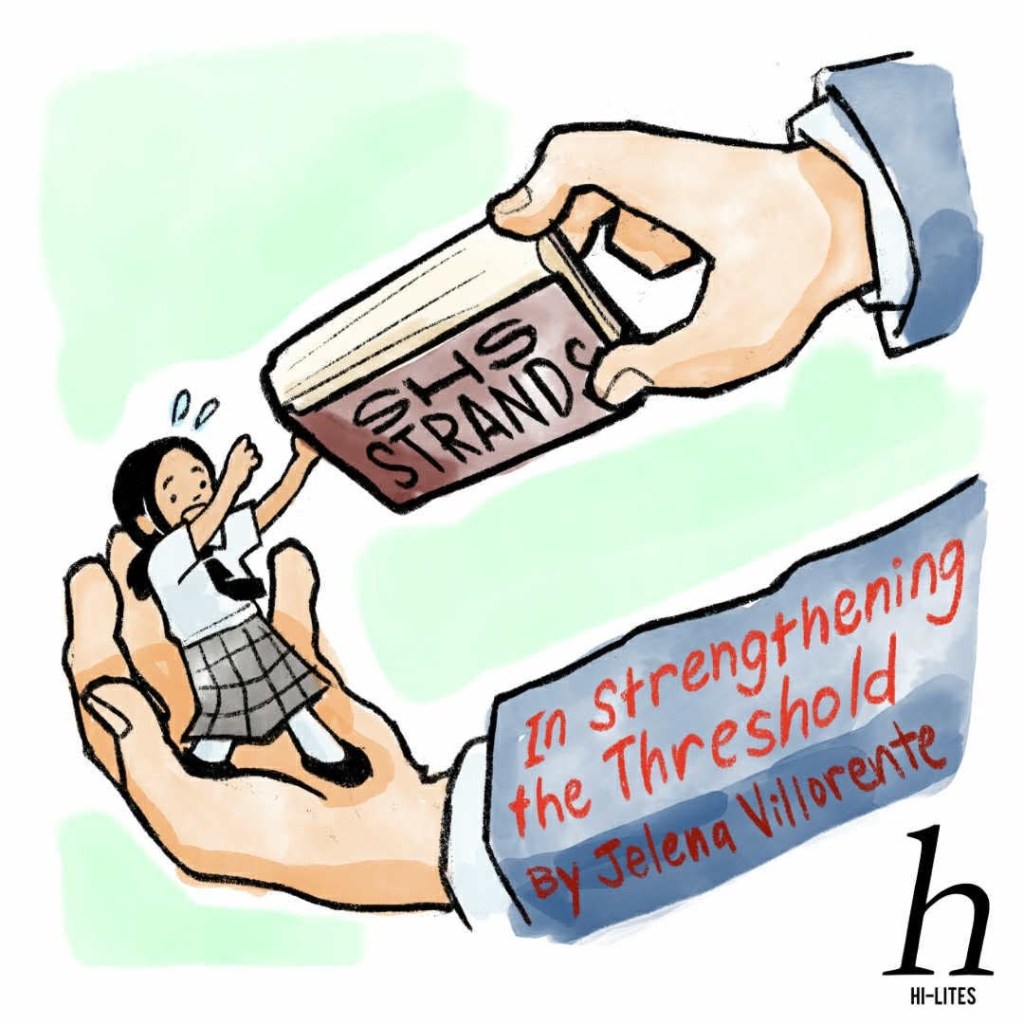
As the latter half of the year starts to bleed through the calendars, the time is due for learning to begin once again as school year 2025–2026 now officially commences for the majority of Philippine schools. In fresh beginnings comes the ebb and flow of change — and in the wake of the new year comes the pilot implementation of the Department of Education’s (DepEd) Strengthened Senior High School (SHS) Curriculum.
From a shifting school calendar to a syllabus reform, amendments this academic year are evidently embraced, all aimed towards the refinement of students’ educational experience throughout the country. Focusing on the latter, this foundational change is currently exclusive to the Grade 11 batches of select schools — as DepEd plans to bring about extensive modifications to the SHS curriculum through new methods of learning and academic rationing.
Introducing this new system is undoubtedly a way to ease SHS students into a more effective mode of education. Its rollout is intended to merely affect the new SHS batches in order to avoid burdening the previous ones into adjusting — but of course, change is multifarious in its nature, and complications are bound to arise.
Undoubtedly, senior high school is still deemed a unique unit of education in the country, serving as a transitory phase towards the whims of college and nudging students into more narrow paths, and with this, it is only best that DepEd tailors this relatively recent unit into one that satisfies student needs.
A Specialized Shift
In its noble pursuit of ‘enhanced quality education,’ DepEd sought to propose a multitude of revisions and additions to the current senior high school framework revolving around various facets. In the official memorandum released last June 14, 2025, changes were made to gravitate towards “streamlined tracks, expanded learner choice, aligned education, seamless transitions, and stackable learning pathways.”
As a whole, DepEd’s chief goal, other than refining the present system, is to remain relevant and responsive to the needs of Philippine education today, especially amidst contemporary qualms. With this pilot implementation, DepEd aims to gain insight into the outcomes of this test rollout, more specifically into the capacities of students and faculty alike, in order to further polish and ensure the efficacy of the approach once it is fully executed.
In line with this, the pilot implementation also spanned a total of 889 schools, 274 of which being private schools and 615 public schools — depicting the participation of the country’s educational branches in achieving this particular stint.
Moving on, the salient features of this modified system include its two main tracks (Academic & Technological-Professional) superseding the previous four — Science, Technology, Engineering, and Mathematics (STEM), Accountancy and Business Management (ABM), Humanities and Social Sciences (HumSS), and General Academic Strand (GAS) — reduced core subjects (Effective Communication, General Mathematics, General Science, Life and Career Skills, and Pag-aaral ng Kasaysayan at Lipunang Pilipino), and offered electives in the place of fixed content.
These were established to subdue the restrictive nature of the past syllabus, especially when it came to subject and work overload, the lack of specialized teachers, and irrelevance in pertinence to employment demands. Challenges such as these cascaded throughout the initial execution of the SHS curriculum and caused quite the turmoil for graduates and their families, especially on the topic of job-readiness and surety.
Truly, it can be said that these changes are major, crudely deviating from our usual perspective of senior high school as an area inclusive of mere strands and specialized subjects. It’s a foundational step; yet, however drastic it may purport to be, it still rings true to the tone of nurturance — more specifically, to its ultimate goal of enabling students to lead their paths upon their direction, little by little.
Upon Rickety Steps
Pursuant to the fulfillment of its purpose, the Strengthened Senior High School curriculum is unwavering in its trek — however, difficulties are inevitable as change begins to set in. Some repercussions to the shift are anchored upon the tribulations it may pose for the pilot schools, especially as they are expected to balance both the implementation of the new program and the maintenance of the original system for the Grade 12 students.
In the very same breath, this becomes a compromise to the faculty’s work ethic, especially given their adherence to two different curricula. For one, administrators would have to tailor schedules that accommodate each batch and ensure its cohesiveness, especially in line with school events. Teachers would have to adjust and develop learning materials that ensure both the integrity of their assigned strands and the efficiency of their new subjects and schedules. A new routine must spring forth for the educators of these schools in order to avoid eroding their capacities as pilot executors.
Despite these fissures, however, the present reforms merely augment DepEd’s brazen stint of improving the quality of education within the SHS unit for the benefit of the students, especially in aiding the Philippine workforce in the process. With the faltering quality of education being a long-established issue in the Philippines, the undertaking of this agenda reveals an unflagging front in responding to this obstinate concern, more so in support of the students and their futures.
On the same topic, the present shift also somehow becomes a callback to the criticisms directed towards the SHS unit, especially in regard to its being ineffective in gaining future jobs and maximizing college education.
According to a survey conducted by the office of Senator Sherwin Gatchalian, 33% of respondents from all over the country are satisfied with the senior high school of the K-12 program, while 40% are dissatisfied. Moreover, 59% said they are dissatisfied because parents have to put in more money, such as for transportation and food, 52% said a senior high school diploma is inadequate to land a better job, while 43% said every family wishes to have their child graduate from college and not merely from senior high school.
Briefly, these turnouts depict a nuance in reception towards the senior high school program, mostly demonstrating the significant disparity present in unmet expectations and financial burden, especially for families who may potentially deem the SHS program unnecessary to their child’s education, as underscored by the last statistic. Overall, this merely accentuates the negative perspectives on the K-12 program and the challenges SHS poses for a significant portion of learners and their families, even despite its promise of specialized knowledge and preparation.
In addition, issues and findings in relation to the relevance of senior high school were also outlined in a thorough curriculum review conducted by the Assessment, Curriculum, and Technology Research Centre in 2024. In their synthesis, it was highlighted that SHS graduates were found to be ‘inadequately prepared’ for college and work, alongside other insights such as the lack of demanded competencies in graduates, unmet expectations with employers, and the undermined benefits of SHS education in the workplace.
After all this, however, the bolstered system itself ultimately culminates atop the lived experiences of the junior batch going through these changes firsthand. From the perspective of Anne Mariano, a Grade 11 student undergoing the pilot program, the new curriculum has impacted her positively as a student in the form of helpful topics and ‘lighter workload.’ “However,” added Mariano, “most of us are still adjusting, and there are lingering ‘what could have been’ thoughts if the strands were still in place.”
Mariano mentioned the advantage of reduced tasks, noting its assistance in preventing a cramped schedule and enabling time for other assignments. On the flip side, however, she stated that “The removed subjects could have been beneficial to us, and that the strands could have prepared us more directly for college by aligning with our intended career paths,” alongside expressing uncertainty about how their procedure of electives would take place.
Meanwhile, Kenji Sai, another Grade 11 student participating in the pilot rollout, mentioned that the new program was a major shift for him as he trudged on despite the expectation of choosing a strand, noting that “it introduced a system that feels both beneficial and frustrating for both students and teachers.”
Sai, akin to Mariano, began by acknowledging the benefit of decompressed subjects. According to him, “These subjects feel more relevant and streamlined, helping me build practical skills rather than just memorizing information. Because of this, my schedule has become more balanced, giving me more time to study deeply, pursue extracurricular activities, and even rest.”
“However,” Sai added, “the transition hasn’t been smooth for everyone. A major downside is how quickly the curriculum was implemented. Many teachers weren’t given enough time to adapt, and it shows in the classroom.” In addition to this, Sai also recognized the difficulty of aligning their current learnings with future careers, given the lack of specialized strands. “Without specialized strands like STEM, HUMSS, or ABM, it feels harder to align our learning with our future careers,” he commented.
One chief concept these opinions establish is the impact brought by the termination of strands, given that it was introduced as one of the program’s major changes. An implication expressed by these learners is the struggle to align SHS learnings with desired college courses and, eventually, future careers — which, still, is the overarching goal of Senior High School.
While employment, as indicated prior by the given statistics, is not ultimately guaranteed once one completes SHS, some students may still deem it as a liminal step that enables them to narrow down their path not only towards tertiary education, but also the future of their choice. Without the aid of concentrated topics, learners sharing the sentiments of both Mariano and Sai may experience difficulty in directing their focus towards the courses and jobs they wish to pursue.
Nevertheless, as demonstrated by these narratives, opinions on the rollout are no less than diverse, especially for the freshmen batch dipping their feet into the waters of a new mode of learning. What tends to be overlooked, however, is that these individual insights eventually amalgamate to form the foundation upon which the program may be improved in the future, and with this very viewpoint, the authentic value of this undertaking then comes into perspective.
Truly, tied to every plan of action is the risk of unprecedented stumbles — yet, to take this very risk is a testament to a dutiful outlook on improving for the sake of steady development.
For the Future of Learners
Amidst the overtones encompassing the realm of senior high school, the certainty that keeps it afloat is the force of those working to maximize its benefit for the sake of the students. However unstable it may purport to be at present, the proceeding labor of fortifying the system remains a testament to the ongoing fulfillment of DepEd’s duty for the youth and their scholastic affairs.
In the end, while the senior high school unit ventures to find its footing, its purpose still reverberates in hopes of bettering the state of education in the country. Clambering atop the summit of success means trudging up unsteady ground, tripping over rough patches, and coming face-to-face with difficulty — all coalescing to become the lessons learned along the way.
Education, truly, remains paramount to the preparation of students for their futures; it is a duty that echoes from the walls of classrooms to the responsibilities of work, a cornerstone of potential waiting to unfold within every individual in pursuit of fulfillment. Learning provides the very steps to be taken towards personal vocation — and it is best that initiatives such as these, no matter how challenging, remain steadfast for the future of our learners and the strengthening of our thresholds.
 HiLites ASHS