
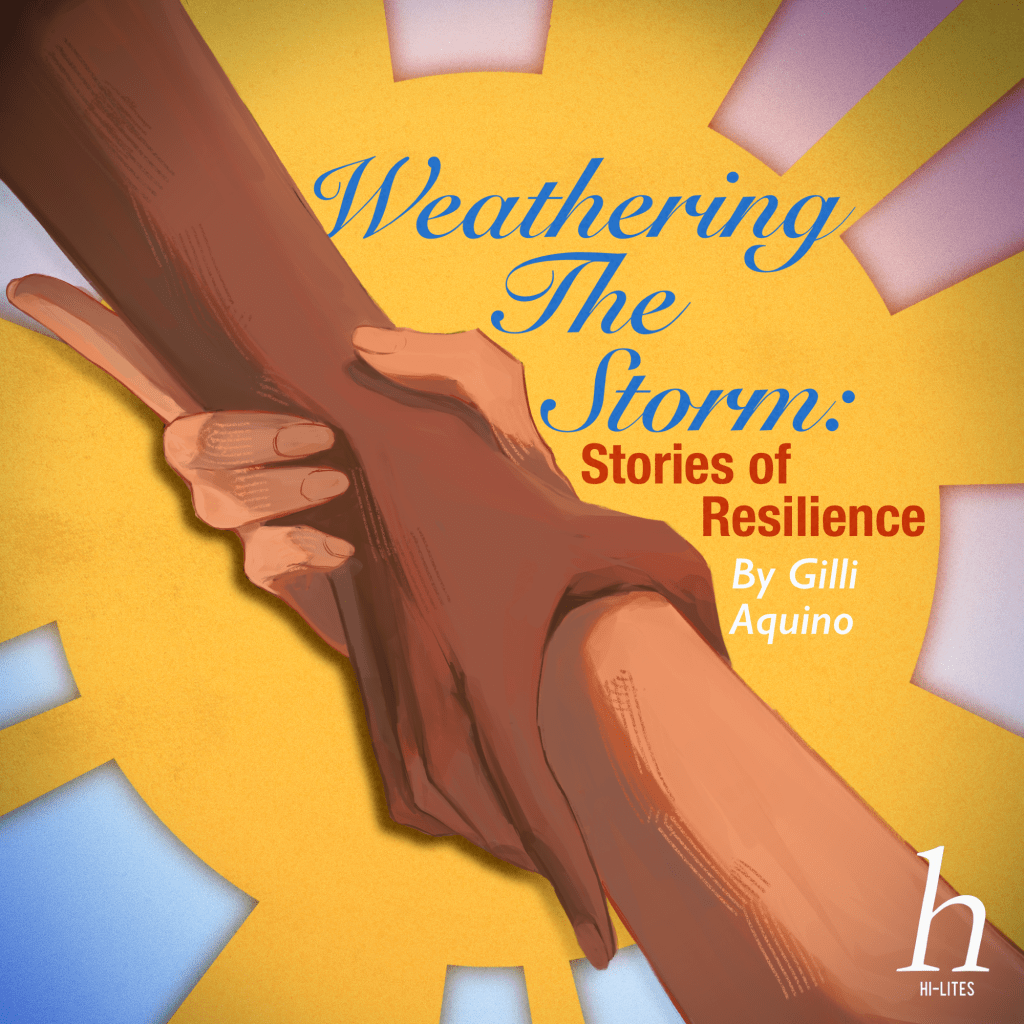
By Gilli Aquino
After days of a downcast sky, the clouds cleared up, letting in the first ray of light succeeding a long, gloomy horizon. Yet across this clear sky exists an even brighter glow — one that reminds us that even in these dark times, a hopeful optimism can emerge. A distant laugh, a cheerful smile, and one hand helping another, all of which prove to be a more vivid beacon of hope.
The Philippines is vulnerable to a wide range of natural disasters due to its location within the Pacific Ring of Fire. Whether it be a mild earthquake or a vigorous storm, Filipinos must be ready for any disaster that may occur. The catastrophe that comes with these undoubtedly affects millions, causing widespread damage across the country. While it takes a great deal of time and effort to fully recover from the aftermath, in between the crevices of this rubble persists a unique strength and sense of unity, one that perhaps encapsulates what it means to be Filipino.
Smiles Among Storms
Amidst the gloomy weather and harsh winds, it is not uncommon to hear anecdotes of those who have had the resilience to rise above it all — lending a helping hand to their community.
Typhoon Haiyan, more commonly known as Super Typhoon Yolanda, was an extremely powerful and destructive tropical cyclone that struck the Philippines in November 2013. While its aftermath led to a long road of recovery, stories of hope and strength have still managed to emerge. Through the aid of World Vision’s livelihood and disaster preparedness program, Aileen, a survivor who was greatly affected by the typhoon’s aftermath, along with other members of her community in Leyte, followed a successful path to recovery. Aside from basic needs such as food, shelter, and nutrition, Aileen and other survivors underwent dressmaking training from the foundation. This ensured a more stable livelihood and means of income for these survivors, allowing them to start their own business.
Additionally, the agricultural sector of the Philippines is a livelihood that is deeply affected by these natural calamities. The aftermath of Typhoon Haiyan had undoubtedly hit farmers the hardest, with crop failure leading to a loss of income. A small village in Lemery, Iloilo, was one of the many towns that experienced this. A 48-year-old farmer, Rosmeraie, was determined to rebuild their village’s farm from the ground up. With this newfound drive, Rosmeraie participated in the Asenso sa Good Agricultural Package (aGAP), which aids farmers in more sustainable work as they learn how to diversify crops and create opportunities to access new markets. The scars of Typhoon Haiyan are still fresh for many farmers; however, with programs such as these, they are now given the opportunity to bounce back even greater than before.
Another devastating event was the Super Typhoon Carina, a destructive tropical cyclone that hit the Philippines back in July 2024. This calamity resulted in heavy floods, disrupting the daily lives of many Filipinos. Edgardo Antonio, a taxi driver from Quezon City, was one of those affected by Typhoon Carina. Edgardo was trapped in his vehicle when the rain started pouring, making it almost impossible to help his family evacuate. As he and his family continue to work towards the road to recovery, Edgardo is immensely grateful to the Tzu Chi Foundation, which provided them with a relief package. This package was a big help to the family as Edgardo was unable to continue working at the time.
The aftermath of each and every one of these calamities has created severe effects on the lives of people all around the country. However, time and time again, there will always be something admirable about the courage and solidarity of Filipinos to rise up even stronger than before. At the end of every passing storm is a glimmer of hope that pushes us to rebuild, restore, and reach out to those who need it the most.
Hope in Help
In times when unity and cooperation are more important than ever, a silent call echoes around the nation — urging others to step up. Several foundations, NGO’s, and institutions have played a key role in building the path to recovery after a myriad of different weather calamities.
CARE Philippines is a humanitarian aid organization that works around the world to eradicate poverty and fight for the rights of women. Aside from this, the foundation has worked to provide emergency relief and development assistance in the Philippines, with quick responses to any type of emergency. Along with this, CARE also empowers local communities when it comes to building resilience against these disasters, integrating disaster risk reduction, climate change adaptation, and ecosystem restoration. A prime example of this is the introduction of their Women Economic Empowerment Project (WEE), which aimed to support farmers after the effects of Typhoon Rolly. This project trained farmers on abaca and root crop by-products, financial management, and other business-related skills.
The Philippine Disaster Resilience Foundation (PDRF) is another foundation that aims to work with the humanitarian sector, non-government entities, and government agencies in strengthening the disaster resilience of communities across all countries. Through actions such as their “Aksyon Para sa Batangas Program,” which deployed relief items in evacuation centers, their emergency response to Typhoon Odett, in which they provided 196,000 ready-to-eat meals and over 200 tons of relief goods, and many more initiatives, the foundation has aided millions of people around the country.
Additionally, Angat Buhay is a non-profit organization that responds to the needs of marginalized communities through a large volunteer network that implements Bayanihan programs. Through providing extensive medical supply donations, rescue operations, volunteer mobilization, large-scale relief distribution, training for disaster preparedness, and many more actions, the organization is one of the most proactive NGOs in the Philippines. This has been seen in their quick response to the aftermath of Typhoon Kristine, in which they deployed rescue boats to aid the evacuation of stranded families. The foundation also distributed hot meals, relief goods, and hygiene kits to the families who were affected.
Aside from these foundations, government agencies such as the Philippine Atmospheric Geophysical and Atmospheric Services Administration (PAGASA) are the main agencies responsible for providing weather forecasts, flood and typhoon warnings, and any other important information related to our climate. Through consistent weather monitoring, the organization aims to provide timely predictions and updates to promote disaster readiness. PAGASA warning signals also serve as the basis for most local governments when it comes to the decisions on class suspensions.
As of right now, according to a 2024 assessment of the Philippines’ disaster readiness, there has been a 42% increase on average when it comes to the level of Filipinos’ self-reported disaster preparedness. However, despite this improvement, this assessment suggests that only 38.4% of the necessary disaster preparedness activities are actually being done. The Philippines still has a long way to go before it can be labeled as 100% disaster-ready. Nonetheless, in times of crisis, it is reassuring to know that numerous individuals are willing to brave the storm with us.
Faith in the Filipino
The frequent occurrences of storms, typhoons, earthquakes, and many other calamities have invoked the traits of unity and resilience among Filipinos as a key necessity to surviving everyday life. However, some would believe that these characteristics have already been deeply ingrained into Filipino culture and history. The cultural concept of “Bayanihan” is deeply rooted in the spirit of communal unity and cooperation. This idea is especially applied to times of crisis, as it represents the act of people coming together to help one another and other communities in need. This ideology is a manifestation of Filipino resilience that is evidently seen in every natural disaster.
While this strength may embody what it means to be Filipino, on the other hand, others would argue that this crosses the line of “glorified resilience.” The concept of glorified resilience in the context of the Philippines essentially criticizes the celebration of Filipino resilience and endurance, believing that this masks the inadequate preventive measures of our government — hindering genuine progress. Some environmental groups in the Philippines have even urged the Philippine government to stop utilizing the “resilience narrative.” In the words of the director of Greenpeace Philippines, “The Filipino people are indeed resilient, yet the narrative of resilience seems to have become a convenient excuse for our leaders to be negligent.” As people continue to celebrate the endurance of Filipino’s, many believe that this celebration must come with the active call to hold those in power accountable.
However, what unites Filipinos at the end of every hardship and newfound challenge is a path that leads back to an unwavering faith. Across all debates, most are united in the belief that true fortitude lies in the heart of a faithful spirit — a fundamental aspect of Filipino culture. In periods of crisis, most survivors draw strength from spirituality and religion. Prayers, masses, and meditation often help people accept their circumstances a lot quicker, giving them significant meaning. Faith-based organizations have also played their part in providing relief after natural calamities. An example of this is shown in Caritas Manila, the social service and development ministry of the church that provides emergency assistance to 50,000-100,000 families annually.
As the sky clears on a new day, each and every Filipino is given a brand new start — one to restore and strengthen what was once lost. It may take a long journey to get there, but it is not one that is braved alone.
 HiLites ASHS