
By Raya Untalan
By JJ Villorente
One of the most stark indicators of a busy city is the abundance of traffic among its roads — and for a region that is infamous for its congested streets, one could certainly deem Metro Manila a hub of hustle and bustle. While it is most unfortunate, traffic is an inevitable part of daily life, comprising a major aspect of everyday routines and out-and-about business for every citizen of the metropolis.
The thing about traffic is that it’s so painfully regular. Everyone who finds themselves out of the house on a periodical basis, whether they’re a public or private commuter or even a mere pedestrian, is well aware of when and where traffic can get hectic — such as on holidays and working hours and across busy areas and avenues — therefore tailoring their schedules in accordance with this unspoken “schedule.”
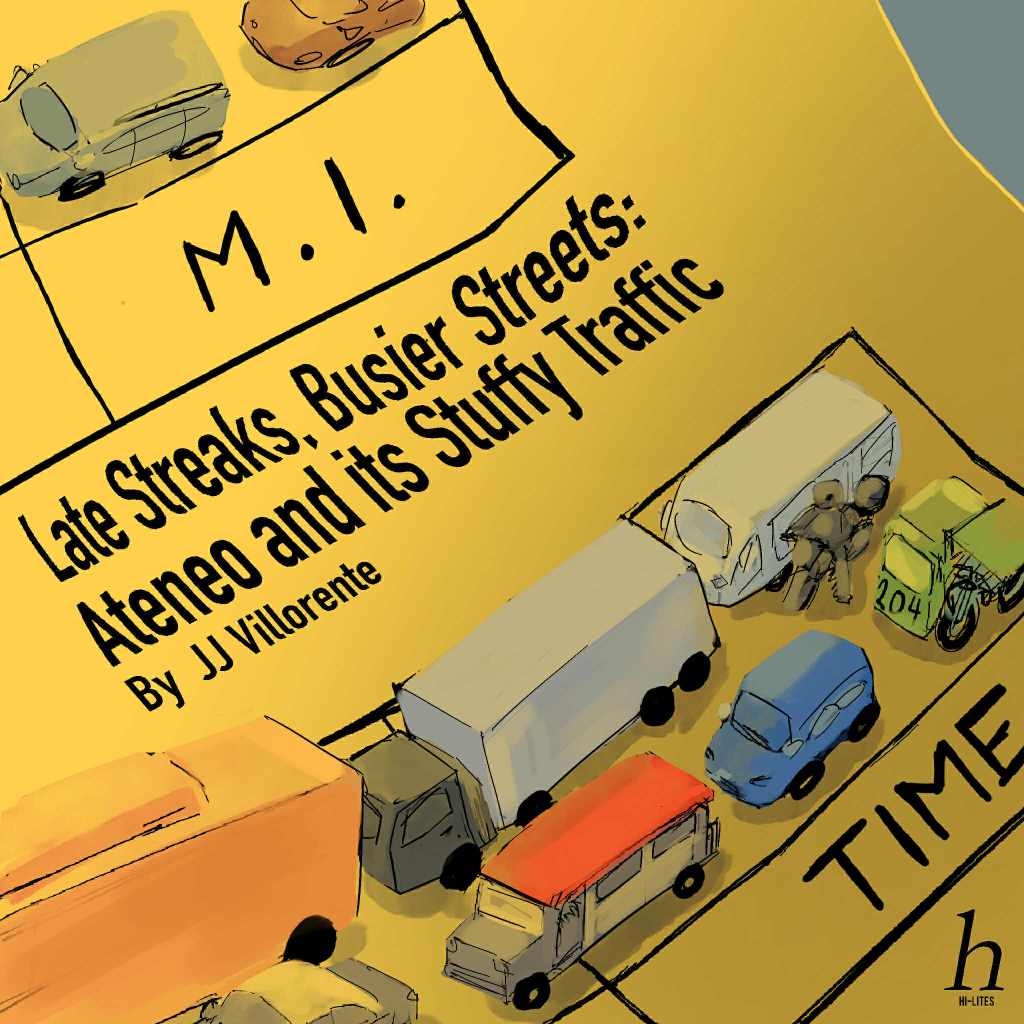
As of late, Ateneo students have come forth with quite the complaint, especially as vehicle congestion has recently begun to take its toll on passersby — and it isn’t just the usual quip about the typical traffic in the area. Apparently, this phenomenon seemed to have worsened very recently, lately affecting students and their punctuality as cars within the campus began to mimic students in long cafeteria lines.
While Ateneo’s general location is typically reputable for its feverish traffic, it has pretty much come to a point wherein many are starting to observe an odd increase in its regularity, leading many to complain about it more than usual. Ateneans are beginning to be issued admit-to-class slips and reprimanded about their poor time management — but, really, does the problem lie within the students that try their hardest to come to school on time?
A Jammed System
It is common knowledge that Metro Manila is absolutely jam-packed with traffic. One could easily tell that this reality greatly catalyzed the expansion of public transport such as railway systems and busways, alongside the enhancement of major roads and expressways in order to encourage the use of public transport and mitigate traffic congestion in specific areas.
These initiatives, however, still do not derail the reality of rush hours, traffic jams, and long rides and waits across the metro. Traffic still forges on and still continues to define the Manila identity, much to the dismay of the Filipino community vying for their right-of-way.
Just lately, the Atenean community has coalesced against the spike of traffic in Katipunan Avenue, and even the city in general. Throughout the campus as a whole, complaints have manifested themselves in the form of freedom wall posts, exasperated rants, and a surge in yellow slips. In a more pressing context, this concern, too, is finding its way back into classroom discussions, as not only students but also faculty members continue to engage into discourse about the worsening traffic situation — all compounding to greatly illustrate how exigent of an issue this phenomenon has been for everyone merely trying to get to school on time.
While students and faculty continue to thread through the convoluted weave of traffic attempting to evade lateness, however, there are some undeniable factors that could have contributed to how traffic has worsened in the campus lately.
One common reason is the influx of private vehicles entering the campus at certain times. A lot of Ateneans, arguably, prefer being brought to school by their own vehicles — even if their cars are in school just to pick them up and or drop them off momentarily, specifically in the case of grade school and high school students. This eventually leads to a jam of cars throughout the streets of the campus, soon amalgamating to become the issue we know of today.
This also ties in with the fact that schedules across campus units may also tend to intersect, bringing forth an unnecessarily congested amount of vehicles within the campus at a time when classes start and end. For one, the ASHS has moved its schedule twenty minutes earlier this year, with classes starting at 8:40 AM instead of the prior 9:00 AM opening — thereby coinciding with schedules of other units as well. Similarly, the AJHS also abolished its Wellness Wednesdays, thus establishing another regular schedule that potentially contributes to the daily onslaught of traffic.
Essentially, even if students eventually disperse towards their own respective campuses, getting there per se is already a difficulty in itself with the sheer amount of cars condensed within Ateneo’s roads.
Moreover, what also stands as a factor for many Ateneans is exactly how far they live from the school — and it is undeniable that a handful of them come from relatively remote areas and deal with the challenge of publicly commuting to school every day. Traffic going to Ateneo itself is already a great hindrance, and even if walking in the campus is an option, the hassle is irrefutably real, especially when most of the exhaustion already comes from having to get to school independently.
Overall, these cascading effects firmly grasp on to students who are unable to beat the vehicular jam, seeing as traffic is admittedly a frequent excuse for lateness and has begun to sound like a broken record for faculty. Some administrators are keen upon not letting this reason slide — but, really, when will the systemic concern be acknowledged not only by these administrators, but by executives as well, when it’s gradually becoming more than just a pain in the butt (literally)?
Perhaps these people just need to wake up earlier. Perhaps they should get used to walking more, or think of another way to recalibrate their schedules in accordance with the unpredictability of traffic along Ateneo. You just know it’s an issue when every stakeholder is expected to adjust to such a deeply-rooted issue — but ultimately, can these two sides of the spectrum somehow find middle ground?
Driven Understanding
At the end of the day, traffic will inevitably remain an inextricable aspect of life, within Ateneo or not. There is no one to blame for the regularity of this phenomenon, given that we all collectively contribute to traffic with each of our day-to-day endeavors — however, little ways could also potentially ease the burden somehow, especially when we’re talking about the reality of Ateneo’s congestion.
For one, carpooling is an option that may aid in reducing the amount of private vehicles entering and exiting the campus. Seeing as a majority of this movement consists of parents and drivers only having to drop off and pick up their children, their intent is to merely be in school for a short time — only to be inconvenienced by the sheer number of cars or vans off to do the same thing. Carpooling prevents this by instigating this routine by groups of students instead.
Tied to this is also the option of being dropped off or picked up outside the campus entirely to ease the amount of traffic within Atenean gates. While you’d have to subsequently confront the Katipunan traffic in the process, in the very least, your ride wouldn’t need to exert the effort to get into Ateneo and navigate its congestion in the process.
Truly, this collective struggle purportedly means more than a mere collective lack of time management. For the majority of student commuters and students who come to school from relatively far areas, they’ve well-learned how to tailor their schedules to accommodate the frequency of traffic across the area and even they’ve been struggling to hold on, especially when consideration is not so easily granted by administrators. These executives cannot merely tell students to simply “wake up earlier” to solve their problems given that traffic these days remains greatly unprecedented — and especially for those who are used to waking up at the crack of dawn to get to school hours later, can you really tell them to adjust?
Similarly, student-initiated complaints must also recognize that administrators aren’t responsible for the congestion that plagues the campus. Vehicular movement is not under their control — meaning they shouldn’t be blamed for whatever trouble the traffic causes, even if their standards are a large inconvenience.
What would be worth evaluating, however, are the schedule changes that have recently been institutionalized for this school year as aforementioned, seeing as this change in timetables seems to overlap so often with the arrangements of other units of the Ateneo. ASHS students are particularly afflicted by the need to come to school earlier when many others are doing the same thing at virtually the same time.
In essence, truly, it is ultimately important that a mutual understanding at least be achieved in cognizance of those who struggle daily in the face of this issue. Each and every Atenean carries their own set of struggles, and even when these tribulations are tied to this everyday routine that everyone else seems to cope with, we never know whether something larger is underlying. All one could ask for is a hint of sensitivity, at least — especially when an irreversible system is in play.
 HiLites ASHS