
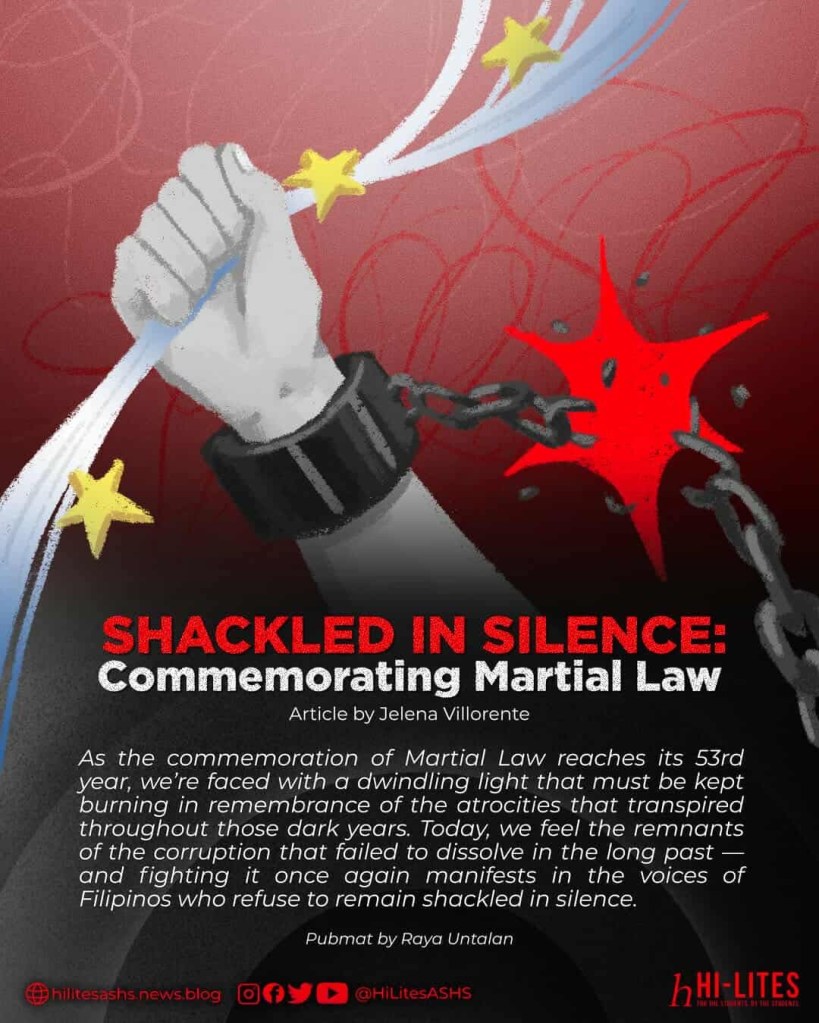
By Jelena Villorente
“Never Again, Never Forget.”
It is a phrase strongly affiliated with the infamous events of martial law, institutionalized by former President Ferdinand Marcos Sr. all the way back in 1972. As of now, 53 years have elapsed since then — yet the stories, the narratives, and the tragedies still ring true to the eyes and ears of Filipinos, never letting go of the turmoil that circulated within those dark years.
While a number of Filipinos may be more familiar with when this martial law came to a close during the People Power Revolution of 1986, when a gilded cascade of yellow flocked the streets of EDSA in fervent resistance, just how many are aware of September 21, 1972 — the day the Philippines was officially penned to be under martial law?
Inevitably, it is true that the hardships marked by this period of torment will still end up being remembered by the few who choose to keep the fire lit; the light has significantly dwindled through the years, evident in the way our own government seems to deem it trivial. Historical distortion threatens to erase the real stories, and it is only a matter of time until mouths are completely sealed shut.
While it seems discouraging, living in a country that continues to marinate in flawed governance only means that its people can merely expect less than the bare minimum, especially when it comes to giving justice to those who have been gravely wronged. When those in authority are lacking, we as a people have learned to take matters into our own hands from the one event that started it all — and it is high time we recognize the transformative gravity possessed by that very period.
A Time of Terror
Martial law is defined as the temporary rule of a particular area by military authorities, typically institutionalized during times of war, rebellion, or natural disaster. Jurisdiction is handed over to the military when civilian authorities are deemed incapable of exercising control over an area, especially in times of crisis.
The Philippines was officially placed under martial law when Marcos Sr. formally signed Proclamation No. 1081 on September 21, 1972, claiming to have done so in response to the threat posed by communist parties and organizations seeking to overthrow the government. Later on, people would come to speculate about the former president’s true intent, claiming that his alleged motives are exaggerated and that he only declared martial law to extend his administration beyond the placed term.
This excuse would remain to become one of the most cold-blooded eras in the history of the Philippines, profoundly shaping our country’s governance and its people to this day. The purported “threat” posed by these organizations cannot even hold a candle to the torture, the pain, and the suffering imposed by the Marcos administration on the Filipinos throughout those years — and the fact that these narratives are still being told and taught today is reminiscent of its lasting influence.
While many tend to remember the revolution by heart, the way the people stood up in peaceful, collective resistance to a government that showed no mercy is greatly understandable, it is also important to recognize what drove this response in the first place. They say the truth may be hard to bear — but when it comes to affairs that concern society, truths such as these must not be suppressed for comfort’s sake.
In its weighted gravity, martial law can only really be affiliated not with a golden era, but with a period of darkness, inextricably bound to human rights violations that made their bloody mark on those years. Extrajudicial killings, media suppression, harassment, oppression, red-tagging, and so many more slithered their way into society throughout those years, and admittedly, it is a pain to confront the truths that settled on the wrong footing.
In cognizance of this era, Amnesty International rigorously documented the human rights infringements that occurred, greatly resembling a pattern of enforced disappearances, killings of those critical of the government, and pervasive detention and arrests throughout this period. According to the same organization, while the true number remains elusive, around 50,000 people were arrested and detained under martial law between 1972 and 1975 alone. Moreover, based on CNN, the Philippines has formally acknowledged that 11,103 people were tortured during the martial law period, alongside 2,326 killings and disappearances.
Up until now, there are still those that continue to suffer the hardship of remembering, especially for those whose loved ones were lost in vicious assassinations. No matter how old you were, you were not exempt from suffering that often ended up fatal, and upon knowing of others’ struggles, you’d be forced to tie yourself up in a frenzy of silence, afraid of being slain for merely uttering a word.
During these times, it is the thousands of people we remember who were tortured, killed, incarcerated, and thrown away like ragdolls for others to witness in fear. It is the journalists, students, priests, activists, leaders, and so many more individuals whom we mourn to this day, those who gave up their lives in defense of the Filipino dignity, with respect for the land they called home.
In this light, it becomes increasingly clear why martial law stands as a time we must continue to remember. It has put the rights of Filipinos into a plunging nosedive and strapped a significant number of lives along with it. It was a time that shrouded the country in shivering fear, under dark clouds and red atmospheres painted in adherence to a totalitarian regime.
Aside from all this, what makes it even more worth commemorating is the fact that it is still continually being erased today — through the subtle stints of our government inching towards a cleanly swept record and past.
Distortions and Travesties
History shapes the present. It continues to define and redefine the course of society, determining the world as it goes round. The erasure of history translates into the erasure of our identity —- and an injustice in the faces of those who fought true struggle in the past, no matter how long ago.
Such is the case for the era of Martial Law in the Philippines, now confronted by the threat of being rewritten, an effort first spearheaded by the government when the EDSA Revolution was declared a special working holiday this year.
While February is now long over, it still comes forth as a blatant spit in the faces of those who battled for freedom amidst those trying times, as their bright yellow march indicated emancipation from a time that painted them in dark silence. It was a harbinger of change for the country — and the fact that it was reduced to less than a holiday of commemoration endangers the authentic remembrance of our country’s liberation, especially for generations to come.
Now that the day meant to honor our freedom faces a sweep under the rug, what more for the day we were officially signed into a depraved period that would continue to haunt us for years to come?
Give it a few years and moves from the government — and the history that almost marked our country’s dystopian future could soon be erased from all official records, textbooks, and documents. It would be no more than a handful of dust in the wind, merely carried throughout the atmosphere by the living voices that continue to keep the narratives alive and moving.
In the same breath, controversy also sparked when the dictator himself, former President Marcos Sr., was granted a hero’s burial under Rodrigo Duterte’s presidency back in 2016. Clad in pearl-white honor, the ceremony came forth as a ritual of disrespect for those who were not even given a proper burial when they were slaughtered under the hands of the person in the coffin. It eradicated all hopes of accountability, as this antithetical decorum only pointed towards remembering Marcos Sr. as an honorable figure — not as the dictator who ruthlessly crushed the Philippine population under his power.
At this rate, this very future could easily wave itself in front of our faces. Our children would not hear the words “martial law” spout out of our mouths with distaste, nor would they hear stories recounting the horrors that transpired then.
Is this the future the government wants? A future of forgotten heroes and unsung narratives? What good comes out of history laid upon an attic shelf, left to collect dust and rot in the corner whilst the future carries the prospect of its untimely repeat?
Succinctly, no absolute benefit is reaped from this initiative, if not to serve the power of authorities wishing to wash their hands clean. Conversely, however, one still cannot deny that the Philippines at present bears stark parallels with our dark past — resembling the corruption that ultimately persisted after 53 years of its supposed eradication. The 1987 Constitution crafted in hopes of wiping the country’s government free of immoral rule seemed to fail in its task, as the Philippines faces an ongoing struggle with greedy, self-praising officials under the rule of our former dictator’s very own son.
Perhaps corruption will always find a way to slither with its scales of deceit. Perhaps history has begun to repeat itself the very same way. It will inevitably come to a point wherein the people feel powerless against a government that merely cares about authority — lest the citizens be unwilling to relent.
Marches of Commemoration
As duplicity continues to take its toll on our nation’s people, September 21st does not only equate to a need for commemoration — but a need for reignition. Forgetting the tragedies that tainted our history could only mean forgetting the individuals who perpetuated it in the first place rendering us vulnerable to the prospect of another bloody, atrocious scene.
Leaving the past in the past is not the answer in this story. Letting the past bleed into the present, into the hearts of those who continue to rebel against wicked governance, and into the youth who are the hope of our nation is the very essence of this reignition, meant to flicker a flame that prevents yesterday’s strings from letting loose.
Today, we see this evident in the rallies, the protests, and the marches being made to strike back at our government for plundering the people’s funds. The “Baha Sa Luneta” rally held at Rizal Park as well as the “Trillion Peso March” at the EDSA People Power Monument both being held on September 21st signify a collective rage, an amalgamation of pent-up frustration at the corruption and nepotism that continue to thieve the citizen’s taxes — profoundly reminiscent of the EDSA People Power Revolution that countered the Marcos dictatorship all the way back in 1986.
Upon glimpsing at the very situation that catalyzed these large-scale protests, we can fathom no significant difference between it and the oppression that transpired 53 years ago. Marcos Sr. enabled atrocities to plague our country back then, taking and torturing the lives of countless Filipinos who dare rise their tongue against his administration — and now, a handful of politicians and officials continue to proliferate the corruption we tried to fight all those years ago, shamelessly stealing from the taxes the proletariats work so hard to pay, all for it to fund their own ostentatious lifestyles.
We’ve witnessed this scene before, and we didn’t like the ending. It all boiled down to Filipinos suffering at the hands of those seated in authority, back then with arrests, killings, and oppression, and today with knee-deep floods, exacerbated poverty, and unfulfilled promises. The fact that nothing seemed to change over the years makes this motif especially significant — and must be the driving force behind the need to call the attention of those who choose to turn a blind eye.
These two rallies saw the fists of an eclectic crowd of Filipinos coming together from various facets of society to converge in collective action. It wasn’t only the activists — it was the students, children, parents, nuns, bishops, celebrities, and so many other Filipinos who took a stand against the corruption that stole from our dignities. Thousands of people, regardless of age, gender, social status, and occupation raised their placards, and this very fact speaks volumes about how grave this issue has become, now causing anyone and everyone to go out of their way and chant relentlessly for their freedom — just like how the People Power Revolution came to be.
Aside from this, the present also brings us to a youthful circulation of unsettling cognizance, through posts and hashtags online that proliferate the blood-stained terror that blotted the Marcos regime in the past. Social media tells us a legion of tragic stories, murders, and tortures that keep the narratives alive, all collectively battling the travesty being painted by the government to downplay martial law’s profundity.
At the end of the day, we are not to let ourselves be shackled in silence, trapped in fear, nor chained in obscurity. Commemorating martial law in its rawest, purest form is a step towards rekindling the candles and reciting the elegies being held for those who suffered under the hands of dictatorship.
It is, in essence, our duty as Filipinos to be aware of the pillars operating within our country, all in service of a nation that still struggles to find its footing. In recognizing Martial Law, we condemn the systems that cultivate immoral cultures and learn from a past that stained our society — to never again undergo the same suffering, and to never forget how it has molded us as Filipino people.
“Never Again, Never Forget.”
 HiLites ASHS