
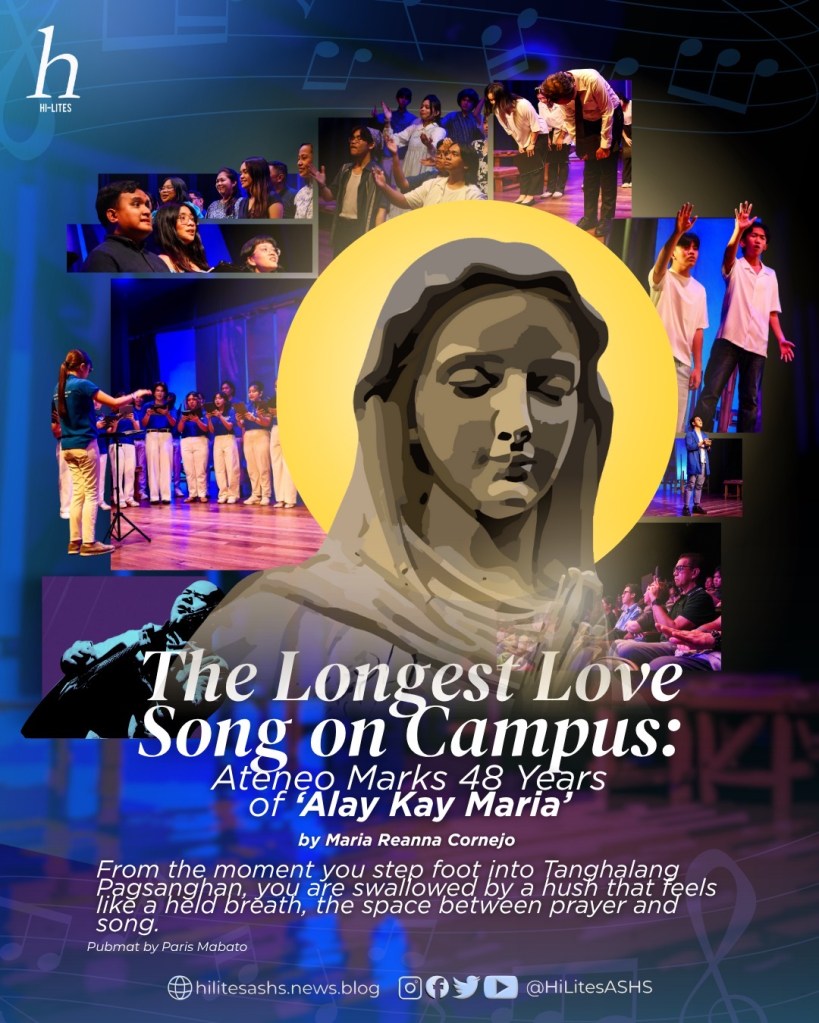
By Paris Mabato
By Reanna Cornejo
From the moment you step foot into Tanghalang Pagsanghan, you are swallowed by a hush that feels like a held breath, the space between prayer and song. A sacred expectancy is formed from the gentle hum of sound equipment settling and the hushed murmurs of the audience. The lights dim, as if the theatre itself leans forward in waiting, and you sense immediately that this is more than a performance. It is a gentle magnet drawing voices, hearts, and a community into one shared breath of faith. The theater becomes more than wood and walls. It becomes a vessel and an altar. And we, the audience, become participants in devotion come to life.
Forty-eight years of song. Forty-eight years of devotion. Every September since 1977, the Ateneo community gathers at an altar of sound to serenade the Mother who embodies grace, courage, and the strength to say “yes” in the face of hardship. This year’s theme, “Stella Maris” or “Tala ng Dagat,” felt both mystical and timely. Mary as an anchor in troubled waters. In a Philippines today marked by turmoil and unrest, her figure of unwavering light is not only celebrated but deeply needed. To sit in that theater was to be reminded that hope can still be sung into being.
A Tradition Nearly Half a Century Old
The first “Alay Kay Maria” began in 1977, introduced as a Marian choral concert presented by Dulaang Sibol of the Ateneo High School. What started as a simple gesture of offering music to the Blessed Virgin has grown over the decades into an annual artistic expression of faith.
The event expanded from a single-organization offering into a campus-wide occasion. Dulaang Sibol began inviting other Ateneo ensembles like student glee clubs, ministry groups, and faculty choirs, and soon opened its stage to Filipino liturgical groups and guest artists. Music ministries such as Bukas Palad ang Hangad also took part, contributing original compositions and signature arrangements, making “Alay Kay Maria” an intergenerational and inter-organizational celebration on campus.
Despite the event changing in size, theme, and participants, it has always remained anchored in Marian devotion. Alay Kay Maria has weathered cultural changes, national crises, social shifts, and even a pandemic. Despite disruptions, it remains an integral part of Ateneo’s event calendar today. The 2025 rendition marked its 48th year and Dulaang Sibol’s 70th season of production, showing how the Ateneo community finds new ways to sing its love to Mary while honoring the weight of the tradition behind it.
Voices, Instruments, and the Stories Told
The breadth of performers was the program’s most impressive feature. Pieces switched between somber and hopeful, almost like waves rising and falling, each carrying the audience through reflection and hope.
The Ateneo College Ministry Group opened with Marian hymns. The songs themselves were prayers, praising her as mother and guide. The Ateneo Senior High School (ASHS) Glee Club and the ASHS Faculty Choir created a conversation between generations where their presences on stage were proof that Alay Kay Maria is where voices, young and seasoned, student and faculty, converge for something greater than themselves. The Ateneo College Glee Club performed a haunting song about Mary losing her son Jesus, a piece led by two male singers whose anguished expressions mirrored the grief in their voices. Their facial expressions and phrasing made the audience feel the story’s human heartbreak.
Dulaang Sibol performed a hybrid form of acting, interpretive dance, and singing in a way that felt both theatrical and devotional. They shifted between Tagalog verses, English refrain, and liturgical echoes. One piece took up Jesus not simply as our Savior, but as brother. Someone who walked among us, who shared our joys, our doubts, our burdens. Every line felt like an invitation to trust that He understands — that He is near and not remote. Another piece was one heavy with the longing to learn to pray, where each voice carried a lament, each asking Mary to teach us how. The performers employed interpretive dance elements like thoughtful expressions, open hands, bowed heads, reaching arms, and fingers tracing arcs in space. Bodies leaned, recoiled, and converged. Every movement called attention to the words, each gesture amplifying what was being sung.
Toto Sorioso drew the audience in with Billy Joel’s “She’s Always a Woman to Me,” comparing the song’s tenderness with Mary’s unending care. He later performed an original composition, teaching the crowd how to hum a simple tune that transformed the theatre into one voice. The Bukas Palad Music Ministry used surprising instruments, alongside piano, they used drums, a triangle, and a shaken percussion that resulted in layers of color and sound. Those percussion accents added a tactile layer to the harmonies of voices. The Hangad Music Ministry followed with a mix of somber and lively pieces, well-known and original compositions — showing that devotion can be both somber and celebratory.
Each group uniquely offered stories of grief, hope, and devotion told through the figure of Mary. Every voice and chord was less about technical display and more about storytelling as prayer. The audience was carried across the whole spectrum of human experience: sorrow over loss, joy in community, asking for guidance, gratitude for maternal care. The program stitched together many individual voices, that expressed devotion in hundreds of different sounds, into one shared narrative of music as a vessel of faith.
Light, Movement, and the Theater as a Sacred Space
One of the clearest artistic choices that shaped the evening was lighting. The intentionality of details such as light, sound, and gestures invited you to reflect. The dimming and changing of colors made an emotional architecture for each piece, whether in the haunting blue of lamentation or the warm glow of joy. At moments of communal singing, the light broadened its warmth and brightness so that the whole ensemble was visible, the entire theatre opening its arms. In solos, spotlights narrowed, isolating the performers in halos of focus while the rest of the stage receded into shadows. When Dulaang Sibol performed a piece that gave nearly every member a solo, each one had a moment in the spotlight. Light would shift from one singer’s figure to the other — almost as if Mary herself was passing attention across voices.
The dimming of lights before each new song also gave a sense of reverence, as though the theater itself was pausing to breathe before the next offering. Through the careful control of the ambience within those walls, Mary became not just a distant figure but an intimate presence, felt within the theatre: our mother, our teacher, our protector.
Community and Closing Reflections
The atmosphere itself was striking; the air inside the theatre was communal and somber. Students, faculty, alumni, and guests all seemed tied by the same threads of awe and gratitude. People bowed their heads during mournful pieces, and they smiled with the performers during lighter moments. This was not passive listening but active belonging, where the boundary between stage and audience dissipates, stage and seats bound by one prayer.
The night closed with all performers gathered together for the final song of Stella Maris. Voices swelled and harmonies filled every corner. This was a communal act beyond the sum of its parts. For in that crescendo of voices that rose like a tide, the tradition’s essence became tangible: Ateneo sings itself home to Mary, again and again. And as the last note of the song rang through, one could only feel certain that the longest love song on campus would continue. As the hymn Ave Maris Stella reminds us, Mary has long been thought of as a guiding star through life’s tempests. Her enduring light does not just matter to the past, but speaks urgently to the present, for her symbolism extends beyond personal devotion and speaks to the collective struggles of our nation. Mary’s steadfastness mirrors our country’s need for direction and guide. In a time when the Philippines faces rising social conflicts, inequality and injustice, political unrest and a restless climate, these performances stand as refuge and declaration. In a country divided by voices that shout past each other, here was a night when voices joined for a common love. Alay Kay Maria becomes a hopeful witness that faith can still shape our horizons. It is a legacy, an offering, a star to steer by. And this year, as the voices swelled in unison to the star of the sea, it reminded us that amid uncertainty and division, faith and song still have the power to guide us safely to shore.
 HiLites ASHS