
By Rhianna Ramos
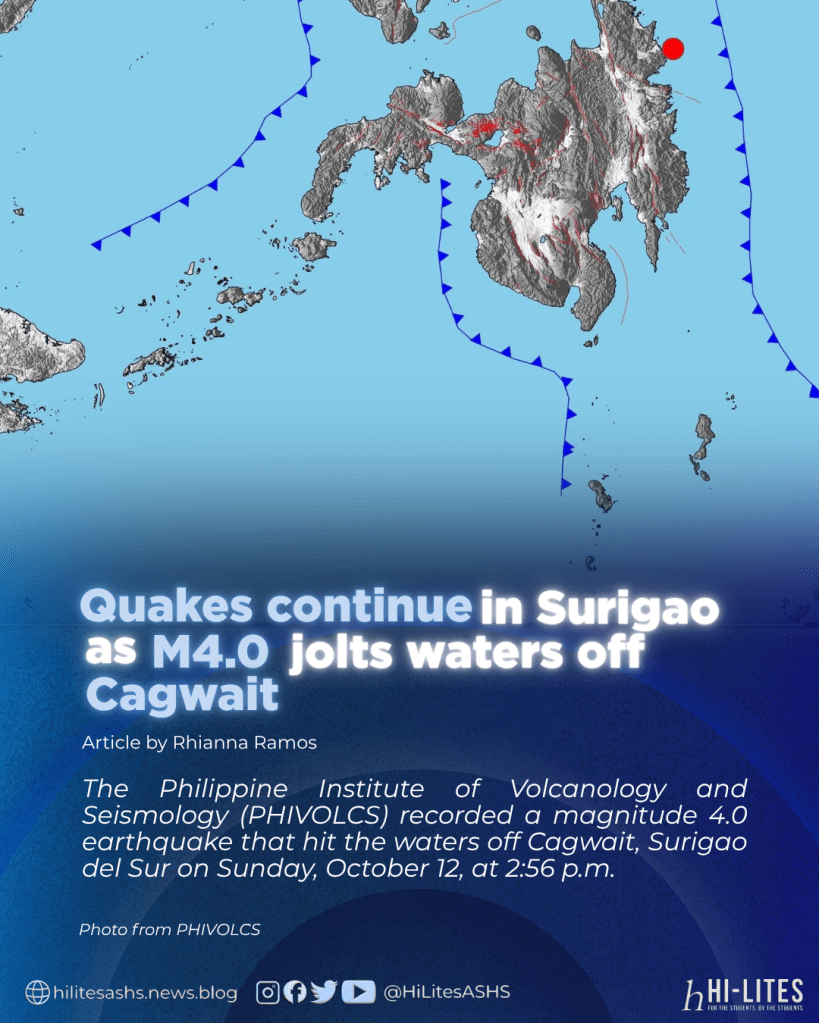
The Philippine Institute of Volcanology and Seismology (PHIVOLCS) recorded a magnitude 4.0 earthquake that hit the waters off Cagwait, Surigao del Sur on Sunday, October 12, at 2:56 p.m.
PHIVOLCS states that it was tectonic in origin and has a depth of 12 kilometers, with no reported casualties or damage done to infrastructures.
The earthquake came days after a series of stronger quakes that hit Mindanao and Visayas, including a magnitude 6.0 quake in the same province on Friday, October 10.
PHIVOLCS also said that the tremor is part of the ongoing seismic activity caused by movements along the Philippine Trench.
Magnitude 6.9 Cebu Earthquake
A series of strong earthquakes shook the Philippines throughout October 2025, causing casualties, damage, and widespread concern among residents in the southern region of the country.
On Thursday, October 2, a magnitude 6.9 earthquake struck near Cebu, killing 74 people and injuring hundreds.
The quake caused extensive damage to various infrastructure across Central Visayas prompting authorities to conduct rescue operations and assess structural integrity in affected areas.
Magnitude 7.4 Manay, Davao Earthquake
Eight days later, on Friday, October 10, a magnitude 7.4 quake struck offshore near Manay, Davao Oriental, leading to tsunami warnings and evacuation across the eastern coast of Mindanao.
PHIVOLCS Director Teresito Bacolcol said the tremor was followed by multiple strong aftershocks and a magnitude 6.8 later that day.
Bacolcol added that the two events came from different fault lines and warned that more aftershocks are expected with decreasing frequency over at least 10 days.
Due to the quake, at least seven people died and dozens were injured in the Mindanao quakes, and although various facilities sustained damage, authorities noted that major infrastructure remains intact.
Magnitude 6.0 Cagawit Surigao Earthquake
One day later, on Saturday, October 11, another magnitude 6.0 earthquake rattled Cagwait, Surigao del Sur, waking residents around 2:30 a.m.
The quake was recorded at a depth of 77 kilometers and felt strongly in nearby provinces, with local officials reporting no significant destruction but continuing to monitor for possible aftershocks.
President Ferdinand “Bongbong” Marcos Jr. ordered local governments to ensure the safety of evacuees and continue relief efforts.
He emphasized that coordination between national agencies and local units continue to provide immediate assistance to affected families.
Furthermore, PHIVOLCS urged the public to stay alert for aftershocks and to follow official advisories, with the agency reiterating that the country’s position along the Pacific Ring of Fire makes it prone to frequent and strong seismic activity.
PHIVOLCS Guidelines for Tsunami
For tsunami-related incidents, PHIVOLCS advises the public of the following:
Before
- Remain alert for Tsunami advisories after an earthquake
- Stay away from the shore after a felt earthquake
- Evacuate to elevated areas once there are unusual sea conditions such as a sudden drop in sea level
During
- Stay away from the shoreline, beaches, and waterways
- Do not return to shore until authorities say it is safe
After
- Continue monitoring updates from PHIVOLCS and local authorities for new warnings or after-effects
PHIVOLCS Guidelines for Earthquake
On the other hand, for seismic-related incidents, the agency advises the community of the following:
Before
- Take note of the hazards in your area
- Learn the evacuation routes and areas
- Secure loose objects
During
- Drop, Cover, and Hold
- Watch out for falling objects such as glass, shelves, and heavy furniture
- If you are outdoors, move to an open area
- If you are near shore, move quickly to higher ground
- If inside a moving vehicle, stop and stay put
After
- As soon as the shaking stops, evacuate the building
- Stay alert for aftershocks
- Listen to updates via radio, Television, or reliable sources in social media
- Check yourself and others for any injuries
 HiLites ASHS