
By Noriko Yamamoto
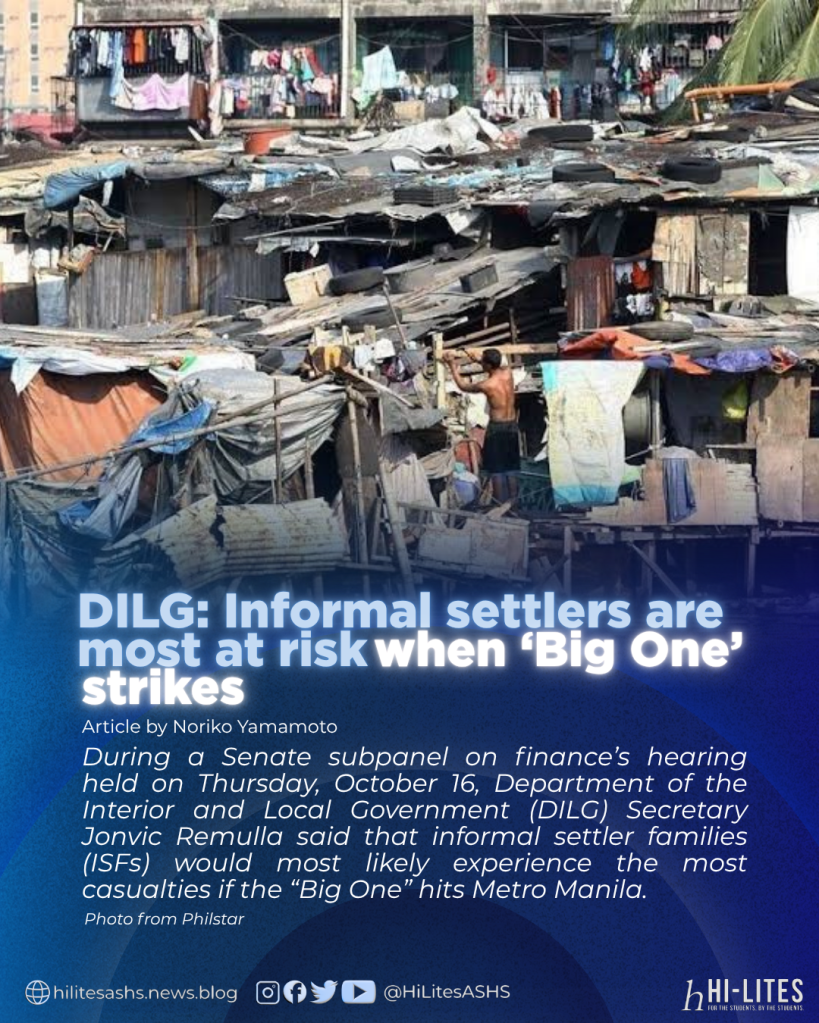
During a Senate subpanel on finance’s hearing held on Thursday, October 16, Department of the Interior and Local Government (DILG) Secretary Jonvic Remulla said that informal settler families (ISFs) would most likely experience the most casualties if the “Big One” hits Metro Manila.
The “Big One” is a projected magnitude 7.2 earthquake that could occur if a major movement happens along the West Valley Fault, which passes through Quezon City, Marikina, Pasig, Makati, Taguig, Muntinlupa, and the provinces of Bulacan, Rizal, Cavite, and Laguna.
According to the Philippine Institute of Volcanology and Seismology (PHIVOLCS), the probability of the earthquake occurring increases as the year 2058 approaches.
Remulla explained that, unlike most city buildings that follow the National Building Code, ISFs are at high risk because many of their homes were built without permits and use unsafe cooking equipment, such as kerosene stoves, which could trigger fires during an earthquake.
To address the issue, Remulla said the DILG will issue memorandum circulars directing Local Government Units (LGUs) to inspect informal settlers’ homes and propose safety measures.
In the same hearing, DILG Undersecretary Marlo Iringan stated the department has developed safety protocols for LGUs to follow during earthquakes.
He added that the DILG plans to conduct an infrastructure audit in Metro Manila, CALABARZON — particularly Cavite and Laguna — and Central Luzon, especially Bulacan and Pampanga.
Iringan also said that LGUs will collaborate with the Association of Structural Engineers, the Philippine Institute of Civil Engineers, and universities offering civil engineering programs.
Under this partnership, fourth- and fifth-year civil engineering students will help assess the structural integrity of buildings across the National Capital Region and nearby regions.
Tremors hit southern PH
Over the past two months, a series of strong earthquakes have struck different parts of the country, raising public concern about disaster preparedness.
On September 30, a magnitude 6.9 earthquake struck off the coast of Cebu, killing at least 70 people and injuring dozens.
Another magnitude 7.4 earthquake hit Davao Oriental on October 10, followed by aftershocks measuring between magnitude 6.7 and 6.8.
However, PHIVOLCS Director Teresito Bacolcol clarified that the “Big One” is not an imminent prediction but part of the West Valley Fault’s natural long-term cycle.
He explained that the fault last moved in 1658 and typically generates large earthquakes every 400 to 600 years, meaning the possibility of another major quake increases as 2058 nears.
 HiLites ASHS