
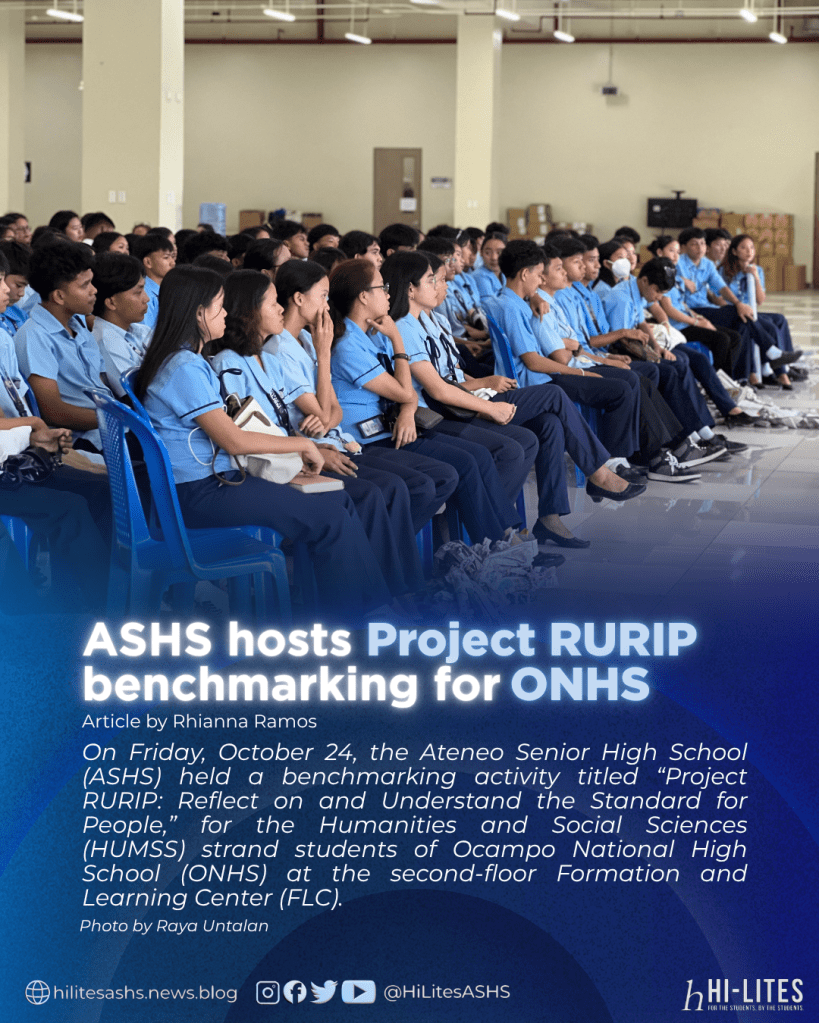
By Raya Untalan
By Rhianna Ramos
On Friday, October 24, the Ateneo Senior High School (ASHS) held a benchmarking activity titled “Project RURIP: Reflect on and Understand the Standard for People,” for the Humanities and Social Sciences (HUMSS) strand students of Ocampo National High School (ONHS) at the second-floor Formation and Learning Center (FLC).
The benchmarking for HUMSS senior high school students has been conducted for three consecutive years by the ONHS and this year, 81 HUMSS students and 10 faculty members were able to attend the said event.
Sir Jonrei Putong, ASHS teacher in Discipline and Ideas in Applied Social Sciences (DIASS), served as the program’s host.
The program was formally opened with a prayer led by Sanggunian President Troy Yusingbo, followed by the opening remarks of the Assistant Principal for Formation (APFor) Ma’am Maria Jennifer Concepcion.
In her opening remarks, Ma’am Concepcion encouraged students to go beyond classroom learning and apply their knowledge to real-life contexts.
She also added that such experiences help students grow into active participants in nation-building.
This was followed by an introduction of the HUMSS program and its Jesuit Philosophy, as well as an overview of the goal of the ASHS Social Sciences courses led by the Subject Area Coordinator (SAC) Sir Josh Madarang.
He emphasized that the goal of Jesuit education is to form individuals who act with integrity and social awareness, adding that this approach requires students to think critically and engage with real-world issues.
Sir Madarang then presented the various HUMSS subjects that the ASHS offers:
- Community Engagement, Solidarity, and Citizenship (CESC)
- Disciplines and Ideas in the Applied Social Sciences (DIASS)
- Disciplines and Ideas in the Social Sciences (DISS)
- Gender Studies (GS)
- Philippine Politics and Governance (PPG)
- Trends, Networks, and Critical Thinking in the 21st Century (TNCT)
- Understanding Culture, Society, and Politics (UCSP)
- Introduction to World Religions and Belief Systems (WRBS)
He also mentioned key points such as the student context and demographics, variations in course offerings and content, best practices in learning strategies, assessments, technology integration, the development of an AI usage policy, and other recent innovations and improvements within the social sciences curriculum.
Moreover, he also highlighted the main challenges in teaching Social Sciences in the ASHS such as post-pandemic learning, the spread of misinformation, and the conflicting nature of discussions on political situations,
After which, the floor was given to the ASHS Sanggunian, who facilitated an icebreaker activity where students formed groups to build the tallest structure using newspaper and masking tape.
Yusingbo emphasized that the activity aimed to test teamwork, communication, and leadership skills among the participants.
After the activity, he introduced the theme of the school year, “Tuloy, Atenista,” and the four main councils — Assembly of Class Officers (ACO), Athletes’ Council (AthC), Council of Student Organizations (CSO), and Council of Student Committees (CSC).
The next segment was composed of an open forum, where ONHS students asked about the ASHS’ gender studies, course variations, and effective learning strategies.
In relation to this, Sir Madarang stressed that studying social sciences equips students to critically assess the world around them.
Various HUMSS teachers also shared some of their learning strategies through classroom engagement, collaborative learning, and the use of technology.
Sir Madarang also explained the school’s ongoing work on creating a concrete artificial intelligence (AI) usage policy and how benchmarking activities help them learn from other institutions.
Ma’am Concepcion then shared that one of the key takeaways from ongoing discussions is the need to be explicit in giving instructions on when students are allowed to use AI for academic tasks.
“We are also working with our existing Code of Discipline, especially in relation to academic integrity. In some cases, AI is also encouraged and used to further the knowledge of students,” she added.
HUMSS club adviser of ONHS and the proponent of Project RURIP Sir Heriberto Bongulto explained that “RURIP” comes from a Bicolano term meaning immersion, aimed to help students experience and learn through interaction.
“This benchmarking activity has been done for three years already and it is substantial to the strand as it helps the HUMSS students adapt and learn new practices and values,” he added.
Ma’am Lily Sola, a Technical-Vocational-Livelihood (TVL) teacher in the ONHS shared, “We, as TVL teachers, focus more on developing the students’ skills and this benchmarking was a great experience for them to recognize other schools and gain different insights.”
Grade 11 student participant Jeanne Raynera said the activity helped her appreciate the strand more and motivated her to apply what she learned.
She added that the visit encouraged them to see the importance of social sciences in understanding people and communities.
The program concluded with a campus tour led by ASHS faculty members, where the students explored the facilities inside the FLC and the Main building.
 HiLites ASHS