
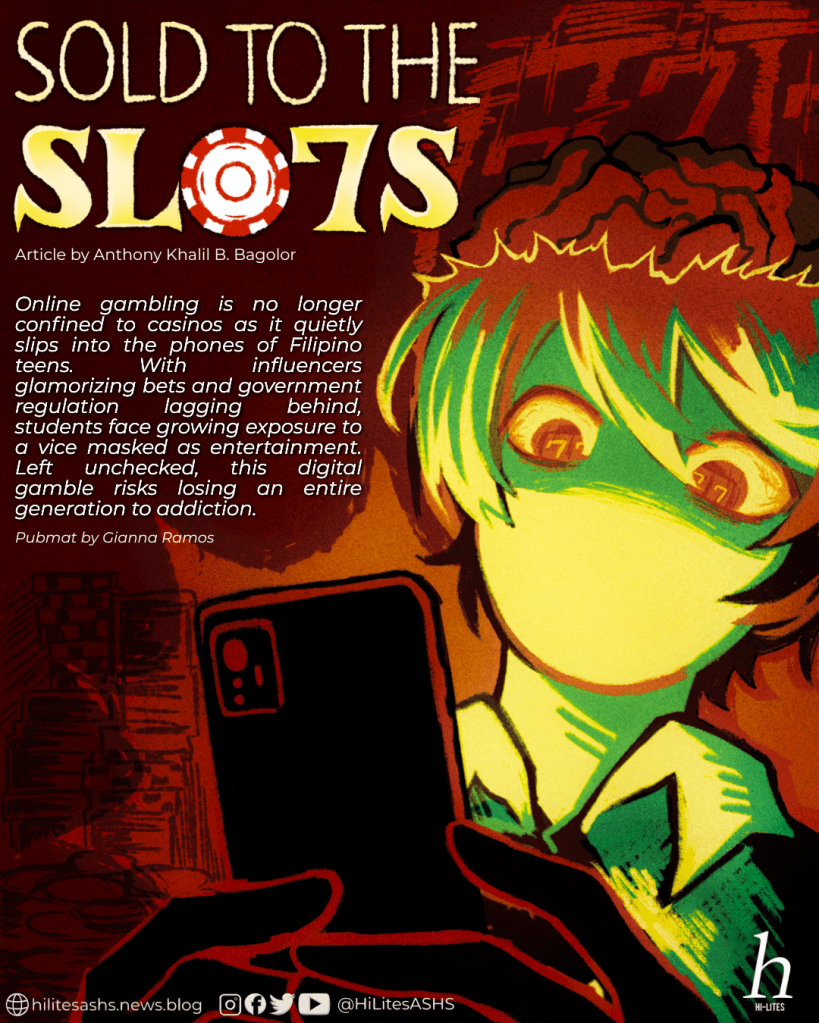
By Anthony Khalil B. Bagolor
Negligence deals the cards, and our youth pay the price.
Gambling is no longer confined to casinos. It has now slipped into classrooms, phones, and most distressingly, the lives of several Filipino students. In recent months, the nation has witnessed an alarming increase in online gambling websites and promotions in unregulated digital spaces. On social media platforms where teens spend most of their time, ads for online casinos, slot games, and betting apps continue to flood feeds, often endorsed by influencers with significant followings. Inevitably, this has placed the youth in a situation where the line between leisure and addiction is dangerously blurred.
According to Representative Rufus Rodriguez, around 30 percent of online gambling users are between the ages of 15 and 24, with many starting before they turn 18. Furthermore, the Philippine Amusement and Gaming Corporation (PAGCOR) reported that over 60% of online gambling sites accessed in the Philippines are illegal, meaning they often lack regulatory safeguards like age verification. As these illegal platforms rise and minors become increasingly vulnerable, the lack of sufficient safeguards has turned online gambling into a silent predator in the daily lives of the youth.
With the continued rise of unregulated betting websites, students like those in the Ateneo Senior High School (ASHS) sit at a frighteningly high risk of gambling exposure and addiction. As adolescents who are deeply immersed in online culture, students spend a large portion of their time on the internet for entertainment or socialization. Unfortunately, this makes them easy targets for algorithms that promote predatory gambling culture. Their constant digital engagement, together with curiosity and peer pressure, fosters an environment where gambling is not just easily accessible but also normalized in daily life.
Chasing Losses
In a study by the World Health Organization, exposure to gambling ads increases the likelihood of underage gambling and addictive behavior in minors due to factors such as normalization. In the Philippines, teens already face immense academic and financial pressure. Coupled with exposure to ads promising “easy money,” gambling platforms prey on their vulnerabilities. They offer what appears to be a quick escape from life’s problems, but these bets rarely deliver. Instead, they trap students in a roulette of loss, compulsion, and debt.
These gambling ads were deliberately designed to promote underage gambling and addiction under the guise of mere online entertainment. They aim to attract younger audiences with their flashy ads, influencer promotions, and humor that resemble usual online content. Common digital platforms such as TikTok, YouTube, and even mobile games have effectively become digital billboards, exposing teens to gambling culture disguised as entertainment. It is alarming to see these ads exploiting the youth’s dependence on social media and their vulnerability to the promises of “quick rewards.”
With unregulated online gambling websites, this makes matters worse. Within just a few clicks, minors can create fake accounts, deposit money through e-wallets, and start gambling without age verification or with falsified data. The line between online games and actual gambling has now become blurred. For students like those in the ASHS or other schools, the risk of addiction grows with every exposure. Gambling can derail their academic performance, leave them in debt, and damage their mental health over time.
Additionally, Department of Education (DepEd) Secretary Sonny Angara warned that a growing number of minors are now gambling online despite these sites causing major academic and financial struggles. Even with calls for stricter regulations and Senator Win Gatchalian seeking a probe into student gambling, the government remains slow to create solutions. “Despite these reported learner gambling incidents, the DepEd currently has not released any specific department order that prohibits or provides sanctions for gambling among learners within schools,” Gatchalian stated.
Regardless of this growing issue, no decisive measures or regulations have been taken by PAGCOR and the government as a whole. The current lack of a modernized and comprehensive policy to regulate online gambling only further exemplifies the vulnerability of Filipino students.
It also does not help when gambling is continuously normalized to the youth. Influencers like Whamos Cruz and Malupiton, who both have a significant youth audience, promote online gambling without second thoughts. Online personalities have now completely disregarded their ethics and are openly advertising casinos websites to their followers while glossing over the immense risks. The youth who idolize these figures are more likely to mimic their behavior, often leading to the glamorization of gambling as trendy entertainment.
Freely-posted clips of influencers betting on games or spinning slots send the horrifying message that gambling is not only harmless but also aspirational. This results in a culture where one associates gambling with status, success, and possibly even inclusion. By failing to regulate this kind of promotion, the government is allowing online gambling to spread not just as a vice but also as a culture that many might emulate.
Bluffing Regulations
While aware of the problem, the Philippine government has done little to regulate gambling ads and promotional content which are frequently encountered by the youth. PAGCOR recently enacted a ban on outdoor billboards and prime-time ads hoping to limit and deter underage gambling. However, digital spaces remain untouched and unmonitored by the government, further propagating the spread of easy-to-access betting sites that often target the youth.
The current measures done to limit underage gambling remain band-aid solutions meant to create an illusion of progress while the real problem festers in digital spaces. It is clear that students do not see gambling ads on giant billboards anymore, but encounter them while scrolling on TikTok, watching YouTube, or even through in-game ads disguised as “free-to-play” entertainment. These digital spaces are the very environment where teenagers spend their time unmonitored which makes it all the more important to protect them from possible exposure to gambling.
In spite of these concerns, regulating online betting remains an economic concern as this may reduce the billions in revenue the government is currently raking in from these sites. According to a report by PAGCOR, online gambling revenue totalled 154.51 billion pesos in 2024 and reached 51.39 billion pesos in the first quarter of 2025 alone. Yet this obsession with profit reveals a troubling trade-off where the government’s inaction is effectively wagering the futures of the youth in exchange for financial gain.
This indifference shows the grim reality of government priorities. By choosing online gambling revenues over the protection of its own people, the government sends a clear message that profit matters more than the nation’s youth. The billions of pesos slipped into state coffers prove that the government directly benefits from the very vice that exploits the young. Their inaction is not just a sign of negligence but also deliberate greed.
The government must recognize that protecting the youth from gambling is not only a moral duty but a long-term investment in the nation’s future. Creating comprehensive regulations like strict age verification systems and banning gambling advertisements on youth-oriented platforms would greatly reduce the normalization of reckless choices to children. To ignore this issue is to risk creating a generation more familiar with slot machines than the stability and security they deserve.
| All or Nothing
Protecting the youth requires more than band-aid solutions or a mirage of deterrence. It cannot be denied that if we keep going in this direction, online gambling will inevitably widen and strengthen its grasp on the youth. In response to this, instead of letting the government continue to prioritize profit over welfare, digital betting sites must be strictly monitored. Age verification systems must be enforced on gambling platforms to prevent underage registration.
Moreover, influencers should also be discouraged and held accountable when it comes to promoting gambling. Irresponsible endorsements leave a lasting impression toward the youth which can fortify gambling culture. This is no longer a matter of entertainment. It is about the exploitation of Filipino teenagers including those in schools like the ASHS.
At the same time, the youth must also learn to be vigilant about the content they consume online. Recognizing the adverse effects of gambling and the exploitative nature of betting ads is the first step in resisting them. By practicing careful discernment and the effects of their actions, students can avoid being lured into decisions that may jeopardize their future. While the responsibility to limit lies with the government, the decisions of the youth are what shape their futures.
Ultimately, the government must step up and treat this as a matter of national urgency, not teen irresponsibility. However, if the government continues to stay silent and prioritize profit, then it falls on us to resist the industry’s wagers and protect the youth. While politicians continue to drag their feet, communities, schools, and youth organizations can begin raising awareness and supporting those already at risk. Normalizing negligence is a tough price to pay so we must act now before the odds are against us.
Every gambling ad the youth sees is another bet on their lives. Only intervening can tip the odds in their favor.
 HiLites ASHS