
By Andy Fuentebella
By Gianna Bacordo
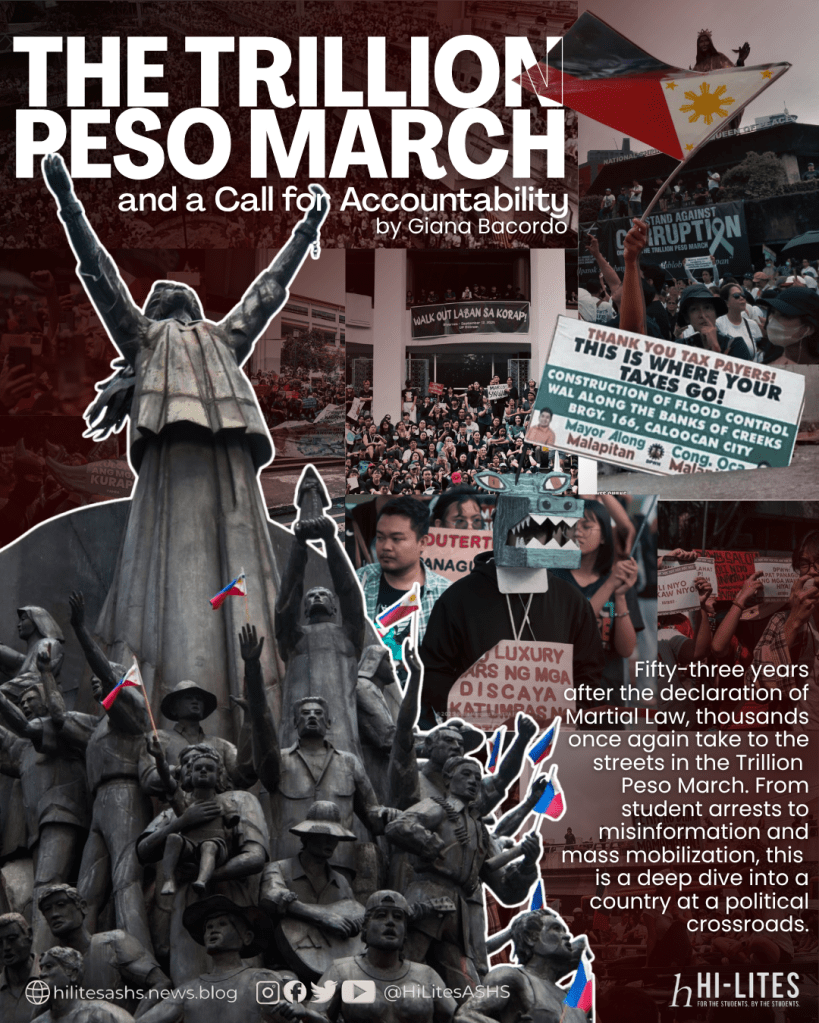
The Philippines, politically, has long been a ticking time bomb. For decades, corruption has drained the nation’s coffers, slowly chipping away at the people’s patience. And on September 21, 2025 — a date that would come to imprint a long-term impression on our collective memory — the Filipino people’s frustration began to spill out onto the streets.
The Trillion Peso March stands to be a pivotal moment in Philippine activism. Organized to protest the ₱1.9 trillion lost to corruption in government-run flood control projects, the movement is characterized by the growing public outrage in the Philippines. To fully understand its significance, one must view the Trillion Peso March in light of the nation’s long history of resistance.
Historical Context
This event is relevant not only today but also in a historical context. The date itself, September 21, marks the 53rd anniversary of Ferdinand Marcos Sr’s declaration of martial law in 1972. His 20-year rule was marred by extrajudicial killings, cronyism, and human rights violations. These events led to a similar protest in 1986: the People Power Revolution. In those three days, nearly two million people protested at EDSA against the oppression and corruption suffered under the Marcos regime, forcing President Marcos into exile. There are strong parallels between these two events; their reminiscent circumstances are a testament to how history repeats itself, and how the fight for democracy in the Philippines is long and ongoing.
The four protest sites further emphasize the cultural significance of the Trillion Peso March. The first was Rizal Park, where Dr. Jose Rizal was executed for inspiring revolution against the Spanish colonial government with his writings. Similarly, he also stood for governmental reforms to resolve the injustices he witnessed. Mendiola Street, situated near Malacañang Palace, has long been a center for Philippine activism, representing the most direct contact with political power. The EDSA shrine commemorates the People Power Revolution, the aforementioned peaceful uprising which brought an end to decades of martial law in the Philippines. Lastly, the People Power Monument is a tribute to the spirit of the Filipino people who fought against the Marcos regime. Together, these locations paint a picture of the Philippines’s ongoing struggle for democracy and accountability from its government. Currently, the Trillion Peso March displays a crisis of institutional trust, an awakening in historical awareness, and the political emergence of the youth in the Philippines.
Philippine Youth and Activism
A number of universities and student groups backed the Trillion Peso March. Among these universities are Ateneo de Manila University, De La Salle University, and Miriam College. In their statement, Ateneo de Manila University called on its students to protest at the EDSA People Power Monument, saying, “Sama-sama tayong manindigan — Para sa Katotohanan. Para sa Pananagutan.” Their statement, backed by the Ignatian values that the university stands for, emphasizes that demanding accountability is both a political and moral responsibility that is shared by all citizens.
It is this mobilization of the youth that is most remarkable about new-age Filipino activism. They are becoming more active in shaping the Philippines’ future, fighting for democracy as emerging participants in society. When the youngest members of society feel compelled to activism, the urgency for accountability and action becomes more and more clear. Continually, the government has failed to lead and serve, and is no longer trusted to protect the future. Many are directly impacted by the flooding worsened by mismanaged funds. The youth are no longer passive observers of this corruption; they are taking up the mantle and shaping the nation themselves.
For years, Filipino students have been taught about their cultural heritage. Revolution against the Spanish colonial government, Hukbalahap, the People Power Protest — this history culminates in the formation of a politically active spirit in the youth. What was also significant was the way the youth bridged online and offline activism. Many protesters were informed of the locations and schedule through social media. In this same way, they were also motivated to go through these protests as they learned about the graft and corruption of certain DPWH contractors. As it stands, social media remains a significant element in politics and activism. However, the dissemination of information it enables also ended up working against the cause.
Fear and Control
On that day, the chaos was further exacerbated by social media. False reports — such as alleged student abductions and a supposed media blackout — spread online, resulting in unnecessary panic. These fear-mongering statements, although later debunked, only deterred citizens from protesting at the moment.
Such unfounded narratives may serve as fear tactics to suppress dissent. Protests, fundamentally, are one of the core ways a community may actively change its conditions, no matter one’s socioeconomic status. This directly goes against the curated inequality that the government has created in the Philippines. In inciting fear among the Filipino people, they stifle the critical voices that may disrupt their hold on power. However, this illusion of control is fading.
Aside from this, some critics have said that the media has been trying to divert attention away from the root cause of the protest. By focusing on the violent outbursts that occurred, they shift public attention from the protest itself to the chaos that ensued. This framing makes the protest seem unsafe and further undermines the legitimacy of the cause.
Social Implications
The Trillion Peso March is a symptom of the social cancer that has long been eroding the Philippines. It brings to light the fragile state of political stability in the country; more and more, the public grows impatient, and their institutional trust declines with each instance of corruption in the government. It is a warning of the growing gap between the government and the Filipinos, a sign that the growing polarization may cause further — yet necessary and inevitable — unrest in the country.
At the heart of the Trillion Peso March is the widening gap between social classes. The stark contrast between the life of the average Filipino person and the politicians who use their taxes makes that even clearer. In between disasters unmanaged by misallocated flood control funds and taxes being deducted from each paycheck, ordinary Filipinos can no longer stand by as their honest, hard-earned money is used to finance the lifestyles of the nepotistic elite. Their resentment has built to the point that thousands of Filipinos have taken to the streets to protest.
However, in contrast, many groups were also brought together by the event. Celebrities and the general public protested as one on that day. Some notable names include Vice Ganda, Anne Curtis, and Catriona Gray, to name only a few. Both veteran and young stars were seen standing shoulder-to-shoulder with the other protestors. In joining, they drew more eyes to the cause against corruption. This only highlights the collective responsibility shared by all citizens, regardless of status, to demand integrity from those in power.
In total, 244 individuals, including 103 minors, were arrested on September 21, 2025. Most of these arrests, having contributed to the succeeding fear-mongering that occurred, were attributed to violence. Public frustration has intensified to the point of outrage. What’s alarming, however, is how swift the government was with arresting citizens as compared to arresting the politicians implicated. The double standards make one thing clear — “one law for the poor, another for the powerful,” as said by NUPL Secretary General Atty. Josalee S. Deinla. The immediate crackdown on ordinary citizens stands in contrast with the legal protection enjoyed by those in power, who face little to no consequences.
Responding to the Trillion Peso March
The fire in the Philippines is not burning alone. All over the world, similar efforts are being made by citizens to retake democracy. Countries like Nepal and Indonesia have also seen youth-led protests calling for systemic change. What unites these movements is a sense of disillusionment among the youth, a demand for urgent reform that will not go unheard.
However, the movement is not just a singular event. Every Friday, the youth hold a noise barrage and candle lighting organized by anti-corruption advocates. The White Friday Protest, its participants wearing white, is the continuation of the sentiment started in the Trillion Peso March. This disruptive demand for accountability, accompanied by white as a symbol of truth and hope, ensures that the message of the march lives on.
In the aftermath of the Trillion Peso March, many have asked the question, “What comes next?” The many answers, while convoluted, all lead to two simple demands: accountability and transparency. The root of the problem lies in the lack of honesty afforded to the Filipino people. For too long, those in power have operated behind closed doors, siphoning funds meant for education, disaster response, and healthcare into their personal reserves. This, consequently, leaves the majority of the public in the dark. The consequences of this dishonesty are felt every day. All of the individuals responsible must be held accountable under the law for their actions. The protection of the corrupt must come to an end. They must be prosecuted, removed from office, and barred from holding public office again. Genuine reform cannot happen if those responsible for the unrest remain in the government. If leaders are truly committed to restoring public trust, they must prove that no one is above the law, especially not those who were entrusted with power and abused it.
The Trillion Peso March, like its predecessor, the People Power Revolution, will be remembered as a turning point in Philippine history. It is a precursor for what’s coming next for the country. As the youth continue to engage with political realities, it is guaranteed that they will play an increasingly significant role in their country’s future. Their actions are a call to the government for immediate action; whether or not they heed this call is to be seen. But one thing is for certain: The youth are watching, and they are no longer silent.
 HiLites ASHS