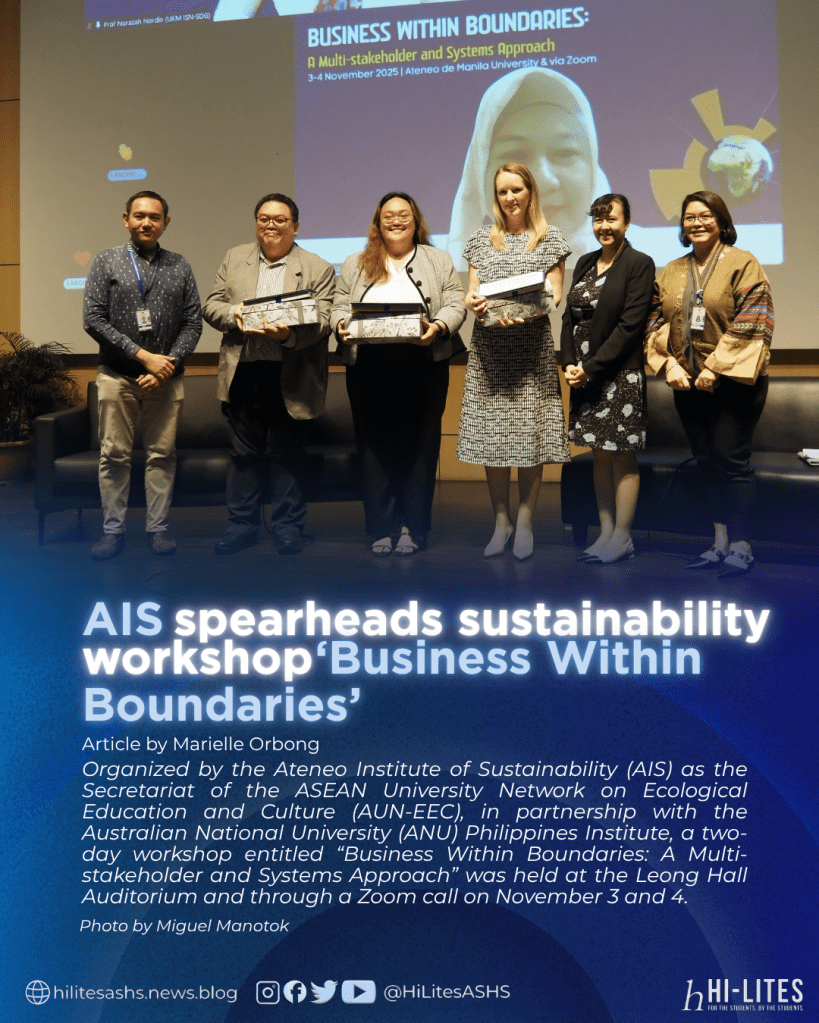
By Miguel Manotok
By Marielle Orbong
Organized by the Ateneo Institute of Sustainability (AIS) as the Secretariat of the ASEAN University Network on Ecological Education and Culture (AUN-EEC), in partnership with the Australian National University (ANU) Philippines Institute, a two-day workshop entitled “Business Within Boundaries: A Multi-stakeholder and Systems Approach” was held at the Leong Hall Auditorium and through a Zoom call on November 3 and 4.
The workshop aimed to catalyze thinking around the changes needed in perspective and practice to effectively do business within the planetary boundaries and facilitate multi-stakeholder collaboration through fostering interactions.
It was attended by different stakeholders, including the academe, business community, local and national government, non-governmental organizations (NGOs), civil society organizations (CSOs), and media.
To formally begin the first day of the workshop, Ateneo de Manila University (ADMU) Vice President Rev. Fr. Joaquin Jose Mari Sumpaico III, SJ, gave opening remarks on behalf of University President Rev. Fr. Roberto “Bobby” Yap, SJ.
In his statement, he highlighted the importance of collective effort by everyone, regardless of their background or affiliations, to preserve and care for our planet.
“As stewards of the Earth, the sustainability and resilience of our common home require the concerted efforts of individuals, communities, organizations, and governments,” he said.
He also expressed his appreciation for the determined individuals from various sectors who have wholeheartedly embraced their responsibilities in promoting sustainable practices.
“Together, we are united by a common goal — to save humanity by protecting the planet. It is a daunting task, but with our collective effort, unwavering perseverance, and steadfast faith, we can succeed,” the vice president added.
First-day Agenda
The program continued with a talk from Dr. Maria Assunta Cuyegkeng, Executive Director of the Lily Gokongwei Ngochua Leadership Academy and Founding Director of the AIS, who discussed “The Sustainability Imperative.”
In her presentation, she emphasized the strong interplay of economy, society, and biosphere, as well as the maximization of environmental, social, and governance (ESG) and sustainability reporting as tools for the evaluation of organizational performance.
After a short break, the second keynote on “The Planetary Boundaries and Sustainability Reporting,” was led by the representatives of the Fenner School of Environment and Society, Australian National University, Dr. Steven Lade, Workstream Lead and Commissioner of Earth Commission, along with Ms. Aryanie Amellina, Climate and environmental policy specialist.
The current states of the nine planetary boundaries were assessed along with the impact identification and action under the corporate sustainability (CS) and sustainable investing (SI) paradigm.
Before the lunch break, the participants were asked to go to their respective sectors for the first workshop, “Examining Your Value Chain.”
For the afternoon session, a panel discussion on tools and frameworks was led by Dr. Lade, Director for External Affairs of Batangas State University Dr. Teodorica Ani, and Chief Operating Officer of the Philippine Stock Exchange Atty. Roel Refran, to discuss the Earth System impact score, UI green metrics, and regulatory frameworks for sustainability reporting, respectively.
The afternoon snacks were then served, followed by the second workshop entitled “Measuring Performance.”
To officially close the opening day program, a brief synthesis on what happened throughout the day was discussed by Mr. Daniel Ratilla, the Program Head for Climate and Disaster Resilience, AIS.
Second-day Agenda
Meanwhile, the second day commenced with a panel discussion on “The Pentahelix Approach to Innovation,” wherein five speakers were invited to share their insights and responsibilities for attaining sustainability from the perspective of their respective sectors.
The academe sector was represented by Dr. Zeeda Fatimah Mohamad, Associate Professor of the Department of Science and Technology Studies in Universiti Malaya; Ms. Judith Gondra, Assistant Director of the Governance Staff of the Department of Economy, Planning, and Development for the government; Ms. Nikki Lizares, Head of Sustainability of the Security Bank Corporation for the private sector; Mr. Elvin Ivan Y. Uy, Executive Director of the Philippine Business for Social Progress, represented the NGOs/CSOs; and Mr. Bry Damasco, Head of Partnerships of Eco-Business Philippines, for the media sector.
Following the first talk, a short break was conducted, followed by the first part of the second-day workshop called “Articulating Sectoral Roles and Interconnections.”
After the one-hour and 30-minute workshop, the meals for lunch were served to the participants before proceeding to the next agenda of the afternoon, which was the presentations from the workshop.
For the last activity, another panel discussion was held focusing on the “ASEAN-Australian Dialogues on Sustainability and Resilience,” in which five speakers from different affiliations tackled the value of multilateral inter-regional discussions and collaborations in addressing the world’s biggest challenges.
To culminate the event, the closing remarks were delivered by Dr. Leland Joseph Dela Cruz, Assistant Vice President for Social and Environmental Engagement for Development and Sustainability of ADMU.
In his statement, he conveyed his gratitude to all the stakeholders who made the workshop a success and emphasized how events like this foster collaboration from the different sectors.
“We all have a role to support businesses by providing frameworks and research and capability building for them to be more sustainable,” Dr. Dela Cruz said.
After the program, the participants were then invited to interact with one another while having the afternoon refreshments served at the Leong Hall Lobby.
 HiLites ASHS