
By Yana Ramos
By Laia De Roma
As the air fills with intense heat and fervor, ringing voices continue to be heard in every direction. Every resounding stomp shakes the ground near you. Outbursts of gleeful laughter from the jolly sea of people become contagious. Fiery chants inspire everyone to join in on the movement. In the midst of the crowd, there exists an entire myriad of wholehearted emotions that long to be recognized. Rage for the wronged. Joy for the accepted. Sorrow for the rejected. Yet no matter the cause, they all march together in both protest and celebration of love.
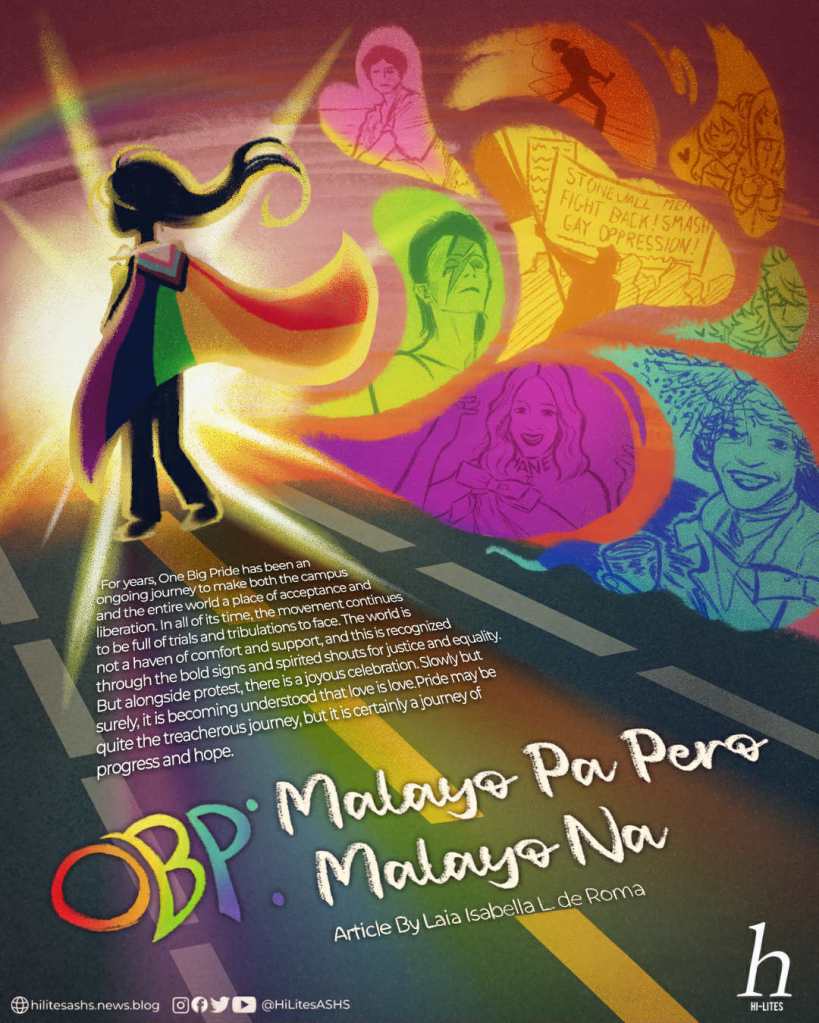
For 55 years, Pride has been celebrated by millions around the world — to make the world not a place of tolerance, but acceptance for the queer community. Ateneo brings in this tradition within campus grounds through the month-long celebration of One Big Pride with this year’s theme of “Tahanan sa Tahan.”
Pride is a crucial journey with the mission of making the world a better place through acceptance and freedom for all, but there is a long way to go. With preconceived perceptions all around the country, queer people tend to feel that there is no hope or malayo pa when it comes to this difficult journey. But with One Big Pride, it is embodied that this is certainly not the case.
Both Protest And Promise
Inside and outside campus, queer students do not always feel safe when living as their true selves. Sometimes, it can be easier to just put on a mask. A mask can always hide the distinct and unique features of anyone, showing only the desirable and accepted among others. But, its constant use eventually becomes suffocating for just anyone. It slowly feels more uncomfortable and unsettling as time goes on, not being able to show who you truly are.
Anya Galang from 11 – Hoyos, shared that she still experiences biphobia, the fear or prejudice against bisexual people based on social misconceptions. “It has gotten to the point where I feel like keeping my sexuality to myself altogether. Overall, it’s kind of disappointing to me sometimes because I can tell that the acceptance exists; it’s just muddled and misinterpreted,” said Galang, highlighting that while living as your true self embodies internal freedom and peace, it also compromises the external with the risk of never being truly understood. Nowadays, acceptance becomes more widespread with every click and share of posts highlighting justice and equality, but it usually does not go beyond the surface level.
Amidst all the rainbow flags, striking signs, and creative makeup, the essence of Pride is still to fight against inequality through advocating for change. Meg Lopez, the Punong Lakambini of Sandigan Lakambini, felt that “It’s not just a parade; it’s a protest and a promise. It showed me that Pride here is both celebration and resistance, grounded in solidarity and compassion. OBP embodies the Ateneo I want to keep believing in, one that embraces inclusivity, justice, and love for all,” further emphasizing that Ateneo is not just an academic institution, but a safe space for everyone to find acceptance and support.
With ever empowering and enthusiastic chants of “Ang beki ng bayan — ngayon ay lumalaban!”, “Abante babae-palaban militante!” and “Ang pride, ang pride — ang pride ay protesta,” the spirits of the sea of people are uplifted to fight back. Proudly fight with radiant smiles and bold placards by not only advocating for change in the systems and institutions that continue to ignore the marginalized, but by fearlessly and freely expressing who they are to the world.
The Youth Are The Future
As said by Jose Rizal, “Ang kabataan ay ang pag-asa ng bayan.” Yet across the country, a young boy is being criticized for preferring Barbie dolls, a tween girl is ignoring her thoughts of a female crush for her family’s sake, and many other similar cases are still happening, even to students on campus. Queerness does not just happen; rather, it is a part of one’s identity, even as a child.
Even in the streets, children are found impersonating drag queens through model walks and made-up gowns with smiles on their faces, but are doubted for being too young. In an inspiring speech by Lopez before the Pride March, she stated that “For too long, queer and trans kids have been told to wait until they are older to be who they are. We are told to stay quiet, to tone it down, to wait for permission to exist. But today, we say: we will not wait. Because we are already here. We are already queer. And we deserve to live and grow in a world that nurtures us, not one that fears us.”
The youth shape the future, but it can only be a great future when the queer youth are protected as well. As said by Meg Lopez, “As queer youth, we carry the future in our hands. But that future needs to be protected, nurtured, and loved. Because the next generation of queer Filipinos deserves to grow into adults who are free, joyful, and unafraid.”
The entire Pride movement focuses on all aspects of time: the past, present, and future. The sufferable history that the community has gone through is recognized, the presently remarkable achievements are celebrated, but the potentially great future of the community relies on the nurturing of queer kids and their dreams.
Having Freedom In Faith
When asked about her expectations of the Pride March, Julia Talan, a student attendee, shared that “Honestly, I didn’t know what to expect for the march, especially given Ateneo’s Jesuit background. However, after seeing the caring organizers, passionate participants, and supportive gazes of onlookers, my worries were proven wrong. This experience showed me that Ateneo can embrace both faith and freedom. It is a community that celebrates diversity not in spite of its beliefs, but because of them.” Queer acceptance may seem to be a kind incentive or generous exception to the rule on campus, but it is only truly practiced within Ateneo because it is genuinely believed that it should be done.
Despite the generalized idea of the church as reluctant to the LGBTQIA+ community, the Church consistently shows its support by providing a safe space for all, regardless of sexuality or gender. This was further embodied by the Welcome Mass held by The Department of Theology and Office of Campus Ministry, in collaboration with the University Gender and Development Office and Gender Hub, to affirm that the queer community has a presence, dignity, and gift in the life of the Church.
Love and acceptance have always been in line with the Jesuit values of Ateneo. Christ-centeredness is a value that is constantly uplifted in the community, and it does not necessarily mean only believing in God, but attempting to embody Him through love. Love is God, and love is God. Being a person-with-and-for-others also means loving our neighbors and accepting differences.
Moreover, besides the usual cooperation between the university and high school to bring together all students and teachers to celebrate One Big Pride, the support of the church shows the solidarity of the entire campus for the crucial movement.
A Beacon of Hope
Through the celebration of One Big Pride, Ateneo has become a place of acceptance. A safe space does not mean simple words of encouragement or appreciation, but the feeling of belonging. As shared by Aren Cainglet, a member of the Sandigan Lakambini, “The ASHS is a traditional school, yet I hope people know that it actually has a very welcoming environment from students and teachers alike. There will be many times when certain identities will feel unsafe or attacked, but the existence of Sandigan Lakambini and the existence of One Big Pride show that there are people who are here for you. You will find your people.”
The Atenean community is made up of thousands of people, yet it has become a safe space for many queer students. If such a large institution can be accepting and loving, then through more movements and advocacies, there will be more safe spaces with people who embrace others for who they truly are.
However, discrimination and prejudice continue to reign throughout society. Not every community has learned to become open-minded towards queer people. The journey that the LGBTQIA+ community has taken towards creating a world of equality, peace, and justice is a long and arduous one.
Nonetheless, the community has no doubt come a long way through the empowerment of its remarkable members, impactful change made through laws and policies, and ever-loving influence on the world. Indeed, malayo pa, pero malayo na.
 HiLites ASHS