
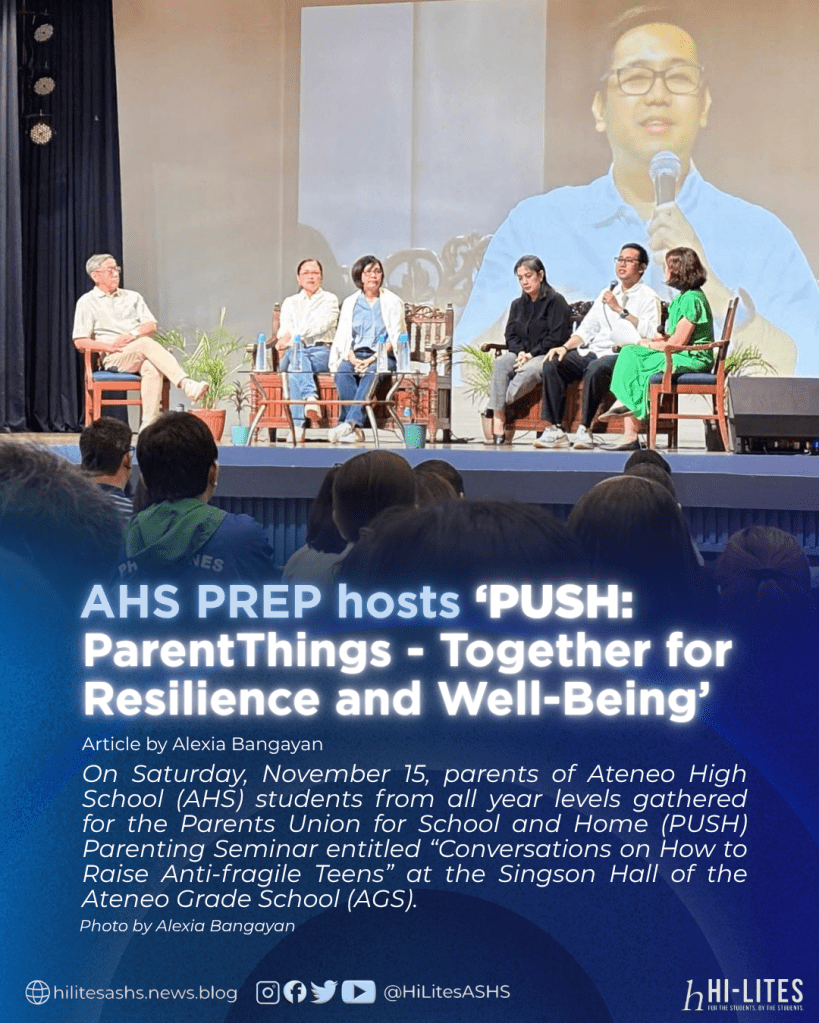
By Alexia Bangayan
On Saturday, November 15, parents of Ateneo High School (AHS) students from all year levels gathered for the Parents Union for School and Home (PUSH) Parenting Seminar entitled “Conversations on How to Raise Anti-fragile Teens” at the Singson Hall of the Ateneo Grade School (AGS).
Organized by the AHS Parents Relations and Programs (PREP), the event aims to help parents understand the concerns — especially mental challenges — faced by adolescents and provide insights for building resilience and emotional strength at home.
Fr. Alberto Ampil, SJ opened the program with a prayer and a reflection using a scene from Facing the Giants to illustrate how parents can support their children by pushing them forward toward greater strength and growth.
Following this, keynote speaker Fr. Jonny Go, SJ, delivered a talk on ‘‘The Art and Science of Raising Anti-Fragile Children,” emphasizing that anti-fragility involves teaching teens to grow from challenges rather than avoiding discomfort.
He also noted that teenagers deal with pressure, comparison, and digital distractions that affect their emotional well-being.
He encouraged parents to provide guidance, boundaries and opportunities for children to handle challenges independently.
A round table discussion followed, featuring a panel of experts in psychology including:
- Dr. Cara Fernandez, Chair, Department of Psychology, Ateneo de Manila University (ADMU)
- Dr. Reg Centeno – Psychologist, Bulatao Center for Psychology
- Dr. Gail Galang – Chair, Department of Psychology, Miriam College, AHS Grade 11 Parent
- Dr. Toni Mactal – Professor, Department of Psychology, ADMU; Ateneo Junior High School Grade 9 Parent
The panel shared approaches for handling real-life scenarios at home and school, drawing on both professional and personal experiences.
They emphasized the importance of guiding teens to solve their own problems rather than simply giving them solutions.
Moreover, the experts highlighted the importance of encouraging teens to prioritize life skills, social interactions, emotional growth and problem-solving in addition to academics.
They also advised parents to maintain realistic expectations and keep communication open so that teenagers feel safe asking for help and expressing themselves.
The program concluded with an open-floor forum, allowing parents to ask the experts questions and seek advice in real-life parenting situations, followed by a closing prayer.
 HiLites ASHS