
By Gianna Ramos
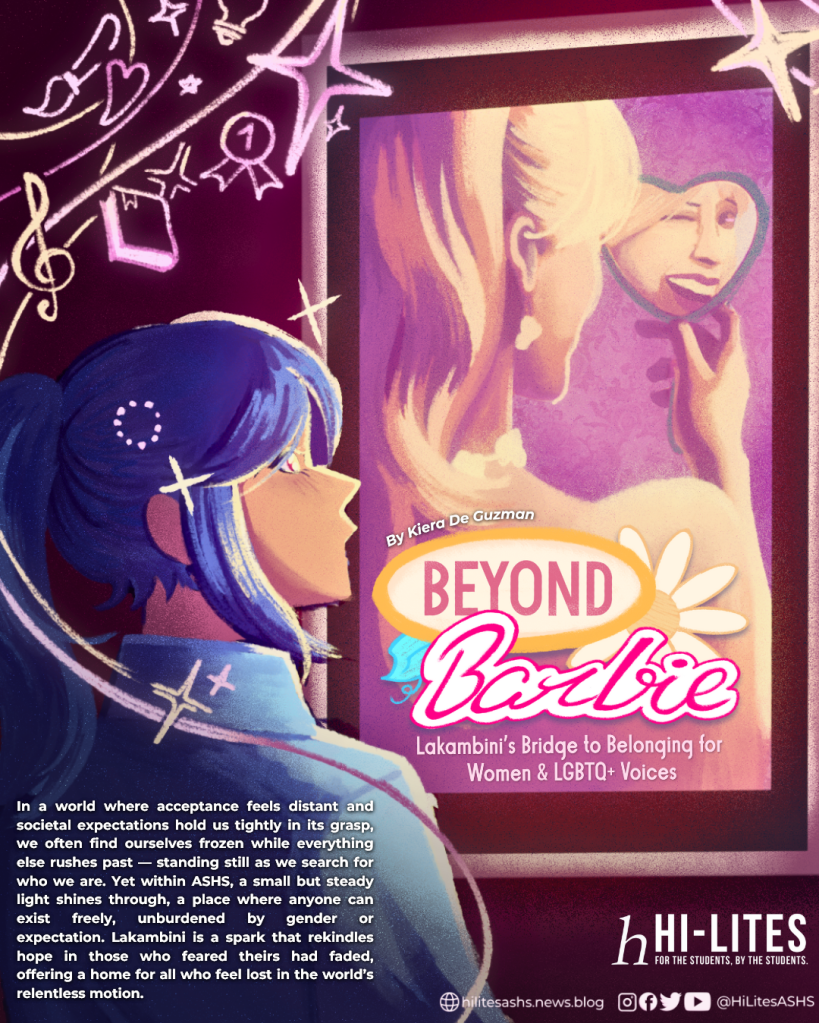
By Kiera De Guzman
“Take my hands, close your eyes… Now, feel.” – Barbie (2023)
In a world that so often tells us who to be, where to belong, which voices are worthy of being heard, and what emotions are deemed right or wrong — we sometimes lose sight of the simple truth — that it’s okay to feel. Too often, self-expression is seen as defiance and feminism as being “too much,” leaving our voices quieted by the weight of society’s expectation.
Yet beneath it all, the heart still whispers that we must simply exist as we are. For inside the campus walls of Ateneo Senior High, there shines a soft, unsteady glow — faint, but unwavering. It is a light born of possibility, a beacon for those whose spirits are dim with doubt. Lakambini stands as that light: a refuge, a promise, a place where hope is gently rekindled for everyone who feared it was gone forever.
A Revolution of Identity
“What makes you different just might be your greatest strength.” – Barbie in a Mermaid Tale (2010)
Among the 8.2 billion people on this planet, no two are exactly alike. Lakambini exists as a sanctuary; a space where every voice is honored, every identity respected, and every person is free to be wholly themselves. In this refuge, students who might otherwise feel unseen or silenced find a home: a place to share their stories, to heal, and to grow. Here, acceptance is not just encouraged, it’s lived.
“Being part of Lakambini means embracing my identity fully and unapologetically, while creating a space for others to do the same. Lakam is a movement that constantly reminds me that femininity and strength can coexist,” emphasized Meg Lopez, the Punong Lakambini, expounding on how being a part of Lakambini means more than just belonging, it means fully embracing and celebrating her identity without apology, while uplifting others to do the same.
It may sound simple, but doing this is incredibly difficult — and deeply important. For sometimes acceptance feels out of reach in a world where we’re constantly taught to conform to unwritten social rules. Lakambini is about empowering those who feel they don’t belong, giving encouragement when their voices are faint, and building a home for anyone who hasn’t yet found where they truly belong.
“Like Barbie, I have felt the pressure to live up to certain roles about how I should act, look, and lead. I love wearing makeup and dresses, and most of my things are pink. But I am also a leader in different organizations and want to pursue a career in law.” Said Gab Beltran, the overall secretary of Lakambini, highlighting how she can be her fullest, most authentic self without being chained by society’s expectations.
Gab emphasizes something deeply important: in Lakambini, she does not need to sacrifice one part of herself for another. “I like ‘girly things,’ and I am proud of it, but it is not the only thing that defines me.” In her words lies a powerful testament to the mission of Lakambini, a space where social norms do not limit her, and where she is free to be genuinely herself.
“Sandigan Lakambini has always been a form of resistance,” explained Andi Bondoc, the communications head of Lakambini. “Resistance to the societal norms that force the binary, resistance to the system that enables discrimination and harassment, and resistance to a world that deems women and queer people as unequal.” In doing so, Lakambini becomes more than just an organization — it’s a movement, a place where marginalized identities are defended, included and celebrated in the face of unjust systems.
Narratives of Becoming
“You’re braver than you think.” -Barbie in Swan Lake (2003)
But it was through constant struggle — the ache of feeling alone, unseen, and out of place — that Lakambini was born and grew into what it is today. There are times when we feel stuck, as though the world spins on without ever pausing for us. Much like Barbie, we wrestle with roles and expectations that don’t actually define who we are.
Yet Lakambini stands for more than just a movement or a home, it is a place of healing for those wounded by the harsh, dismissive voices of the world. Here, we are given the space to reclaim ourselves, to exist fully and freely, beyond what others think we “should” be.
“One of the biggest expectations is that femininity should look and act a certain way: soft, quiet, and delicate. But Barbie shows that there is no single way to be a woman, and that is something I deeply relate to,” expressed Meg, speaking on the restrictive and unrealistic norms that society often imposes. As a trans woman, she explains that there are unspoken rules about what a “real woman” should be, rules she refuses to be bound by. “Lakambini challenges that by celebrating diversity in expression. Being a member of Lakambini is not about fitting an image but about living authentically.”
It’s really the personal stories — the victories and defeats, the raw emotion they carry, and the pure authenticity of each Lakambini member — that define what Lakambini is today. Each member weaves a strand into a larger tapestry of strength and hope, making Lakambini a living and breathing force for change.
“When you’re queer, you can never really avoid the discrimination and stigma, a sad reality that is still present today. Growing up, people would always tell me that it was okay to be gay, but in order for society to accept me, I would have to present myself in a way that was “palatable” to all,” reflected Roby Enriquez, the brand’s head of Lakambini, going on to explain how this pressure to conform isn’t just a personal issue but it reflects a broader social pattern rooted in rigid gender norms.
These norms place harsh limits on how queer people are “allowed” to exist. In reality, there is no single “true” way to be queer. Gender is fluid, and people’s identities and expressions don’t need to fit into narrow boxes, no matter how strongly society insists otherwise.
For Roby, Lakambini is a radical act of defiance. It’s a space where queer people don’t need to tailor their identities to fit what others consider “safe” or “nice.” Instead, they are empowered to be seen in all their complexity — not just in ways that are easy for others to digest.
“Growing up, I had a hard time with my sexuality and gender identity. I grew up in a home where being queer was wrong, and was unacceptable. For years, I tried to hide who I was and play a part that wasn’t meant for me. But as I grew older, I knew that who I truly was isn’t wrong, that I am perfect the way I am,” Andi shared how embracing her vulnerability was a turning point, a courageous openness that ultimately fueled her growth and empowered her today. This captures the spirit of Barbie beautifully: just like Barbie’s journey toward self‑acceptance and authenticity, Andi’s honesty becomes the foundation of her strength.
These stories and human experiences of each individual member become something far greater than themselves. They are the very threads that build Lakambini into a steady, loving home: a kind of “Barbie house” of acceptance, where no one is pressured to play a part they weren’t born to.
“Being part of Lakambini feels like coming home to a version of myself I used to hide. It’s a space where I can be loud, soft, unsure, and passionate na sabay sabay, and still be seen. Lakambini reminded me that there’s strength in softness and courage in being seen,” said Isaiah Legarda, the membership development head of Lakambini, emphasizing how Lakambini serves as a powerful reminder that we are enough just as we are, and the doors of their home will always remain open to anyone seeking their own place of belonging.
Planting Seeds of Change
“Every star is there for a reason.” – Barbie Mariposa (2008)
Lakambini exists not just to imagine a better, more inclusive world — but to design it, one humble step at a time. By weaving together their stories and their visions, the organization sets the stage for change: change that begins from within, but ripples outward. Ultimately reshaping hearts, challenging norms, and building a future where every person can breathe freely and unapologetically.
“The very existence of Lakambini is already a powerful first step, but there is still so much more to do. I envision Lakambini continuing to transform Ateneo into a space where inclusivity is not just a concept but a culture,” said Meg, her eyes lighting up as she imagines what could be. “Success for me is not measured in numbers or recognition but in seeing members feel seen, validated, and empowered to be themselves. When someone finds their voice or their sense of self through Lakambini, that is already a success worth celebrating.” In her hopeful vision, Lakambini becomes not only a refuge but a catalyst: a movement that moves the campus toward belonging, acceptance, and real change.
Lakambini aspires not just to exist, but to grow: to expand its reach, deepen its impact, and transform its vision into a lived reality. Through ongoing dialogue, activism, and community building, it aims to turn inclusion into a true culture.
“Going back to the saying ‘malayo na, pero malayo pa,’ I believe that it is important to recognize how far we’ve come in the fight for gender equality, but it is also important to recognize that there is still so much that can be done. The fight for gender equality has truly come a long way, but it’s only the start.” Roby went on to explain that as Lakambini exists as a powerful starting point, there is still so much more to achieve.
Many still cling to narrow views; unaccepting, closed‑minded, and dismissive of those who don’t fit the mold. In the Philippines especially, LGBTQ+ people and women remain marginalized, often judged by rigid gender expectations that label them as ‘unnatural’ or ‘less capable.’ But Lakambini refuses to be defined by those prejudices. Instead, it stands firm as a pillar of hope for those afraid to show their true selves; inspiring courage, validating identity, and reminding everyone that you deserve to be who you are.
“The primary goal of Lakambini is to not exist anymore. For every space to be a safe space. For everyone to feel empowered. For everyone to be accepted for who they are. As of now, this seems like a far dream, but we have been making significant progress towards our shared journey of inclusivity.” Andi admitted that it’s been a long, exhausting road; a journey marked by struggle, doubt, and hard‑won growth. But she and everyone at Lakambini are willing and more than ready to keep going and keep fighting for what they stand for.
She then continued, “While we still have a long way to go, Lakambini is adamant in pushing forward change never before seen, to put advocacy in the forefront, and to solidify its presence and importance to the ASHS and society as a whole.”
In the spirit of Barbie, Lakambini embodies that same radical self‑acceptance we see on screen — where identity isn’t prescribed, and perfection isn’t the goal. Just as Barbie learns there is no one “right” way to be, Lakambini champions the beauty of being wholly, unapologetically yourself. In this shared space, members don’t just find community — they discover that their stories matter, their struggles are seen, and their authentic selves have a place to shine.
In Lakambini’s glow, like a Barbie stepping out of her stubborn plastic box, we learn that being human, in all our imperfect and beautiful truth, is enough to change the world.
 HiLites ASHS