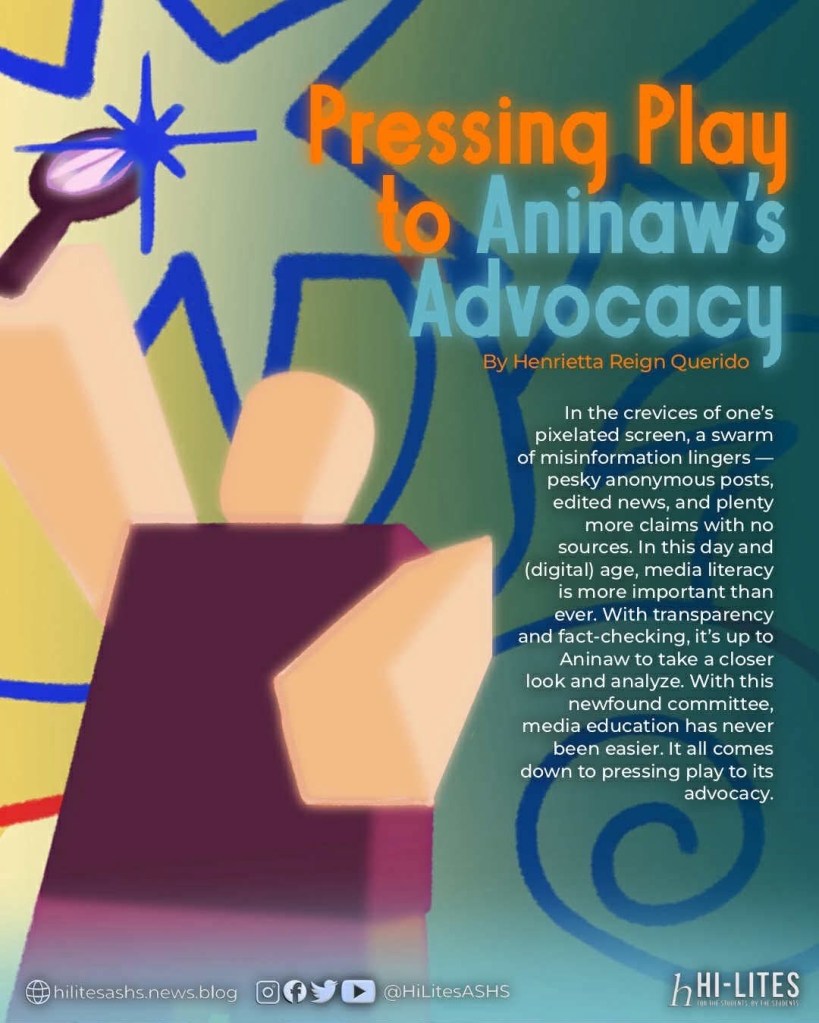
By Reign Querido
“Oof!” The character winces. With its bloxy build and headless style, a Roblox character has once again been scammed by a troll. In the world of online games, where “Adopt Me” pets are stolen and fake Robux links have been redeemed, it’s hard to keep up with what’s real and what’s fake. Beyond the screens of the internet, it’s up to us to discern.
But outside of these pixelated screens, misinformation doesn’t just come out of shady links and weird popups, because with misinformation, it’s more than that. In a school setting where stories travel like lightning speed, the fine line between a fact and a lie blurs. The one to unblur it to make something digital so clear is no other than Aninaw.
How to Play
True to its name, Aninaw is a hive of transparency and visibility. Aiming to provide a guide in fact-checking to the Ateneo Senior High School (ASHS) community, its cognomen is just a gist of what they truly can do for media literacy. Ricci Torio, the committee’s head, voiced out who exactly they are. “We not only want to provide fact-checking and anti-disinformation initiatives to the ASHS community, but we also want to provide a space for students to learn the necessary skills.”
More than just a fact-checking committee, Aninaw serves to make more people aware of what lingers in the media. Richard Hernandez, a member of the 2025 National Media Information Literacy (MIL) Quiz Bee team, shared how understanding media literacy is a life skill. “Media literacy is more than knowing, it’s doing, in a world where information spreads fast and technology develops even faster, being media-literate means thinking critically, asking questions, and staying aware of how information affects us.” With Aninaw’s advocacy, students are encouraged not only to be wary but also to engage and analyze carefully. It contributes to making the student body into an active user of technology rather than a passive one.
While MIL has been a long-standing subject, Aninaw has stepped foot to battle the misconceptions against it. “A common misconception I had was that MIL is only about identifying credible sources or avoiding misinformation. After the quiz bee and seminar, I realized it’s much broader.” Hernandez explored how media literacy involves understanding how media influences others, how technology changes communication, and how individuals can participate responsibly in digital spaces. Even in the organization itself, misinformation can always inhibit. Combating it by realizing what media literacy consists of stops the spread — not only in the false crevices of lies, but also a domino effect of letting blatant misinformation continue.
As every confused look in an online game — whether it be a horror escape room, a bingo simulation, or avoiding a deer — misinformation can prevail. Aninaw holds the connection to enjoying what’s online while still being able to be an active participant in advocating for what’s true. No matter how relatively new this special committee is, what they uphold is something lifelong, a skill every student should hone.
Pressing the Play Button
As Aninaw brings their advocacy outside the screens, it’s up to you to press the play button and do your part. With social media platforms being in everyone’s pocket, abolishing the rampant effects of inaccurate facts isn’t always a press away. “In public online spaces such as social media, negative and offensive communication with no perceived accountability or responsibility is very rampant today,” Torio said, “this very much discourages meaningful exchanges of information that are rooted in seeking truth, honesty, and goodwill.” A place where cancel culture, AI and deepfake videos, and accumulative hate, it’s easy to be blinded from the truth.
With this, Torio stresses how fact-checking prevents what infiltrates the digital screen, no matter if the algorithm isn’t always on their side. “I believe that many people aren’t very aware that fact-checking posts and articles often don’t reach the same large audiences that misinformation reaches.” It might not absolve the sneaky posts in a person’s timeline, but it recognizes the misdeed it contains and wards off future offenses. “Fact-checks are more of an important step in the greater solution of fostering a culture of media literacy and truthful information.”
As the game ends and saves, combating misinformation isn’t the only thing Aninaw fights for. By using one’s awareness, a shared responsibility between every student can create a digital world of truth. Even small habits like believing without checking the author’s name, spreading rumors online by masking it with anonymity, and even a simple act of ###### in the Roblox chat, can create a ripple effect of a never-ending line of lies. Media literacy, in game terms, will always update each time you verify the minds where truth lies.
Recommended For You
As CSC week comes to an end — where Aninaw invites everyone to voyage through their advocacy — the committee still has more in store. From their “Knock Down Fake News” to their Roblox games, Aninaw is in pursuit of acknowledging the truth. To continue the CSC Awareness Campaign, a Roblox 2D platformer has been released, too. These acts aren’t just for enjoyment but to equip everyone with skills that can reflect in everything one does. Hernandez emphasized just how important media literacy is. “Take MIL seriously. It equips you, not just for school, but for your future roles as informed, responsible, and empowered citizens.”
Aninaw calls on you to take their initiative seriously, too. As they launched their project, Media EducAItion, last October 20 to 24, AI literacy has never been more profuse than this. Through their educational but thrilling platform, more than 200 participants have been part of their cause. In line with the celebration of the Global Media and Information Literacy Week, Aninaw featured its very own Roblox Escape Room filled with MIL and AI literacy side quests. As they incorporate the very platforms that house a lot of misinformation, it’s up to Aninaw to turn it around and use its advocacy to change it for the better.
Staying through to its claims, Aninaw has also been instrumental in debunking fake news from several events. With the Trillion Peso March and Baha sa Luneta being a country-wide initiative, it’s never too safe to assume that the information spread was true, no matter its intentions. Through the committee’s social media posts, the claims of the masses are fact-checked and have long been used as a tool to understand the country as a whole. By letting the student body become part of the initiative, they have launched a request form, too, to better understand what should be corrected, what should be featured, and what should be improved. With Aninaw, it’s never just the committee that moves; it’s a responsibility between each and every one to know.
“Oof!” The character winces. With its bloxy build and headless style, a Roblox character has once again been removed because of its troll tendencies. In the world of online games, where Adopt Me pets are stolen and fake Robux links have been redeemed, Aninaw serves to debunk it. They don’t just correct facts; they call everyone to discern and become an active participant in the digital world. As they teach how to question carefully and participate responsibly, it’s in due time for misinformation to cease. It’s now your call to press the play button, because with Aninaw, it calls you to look.
 HiLites ASHS