
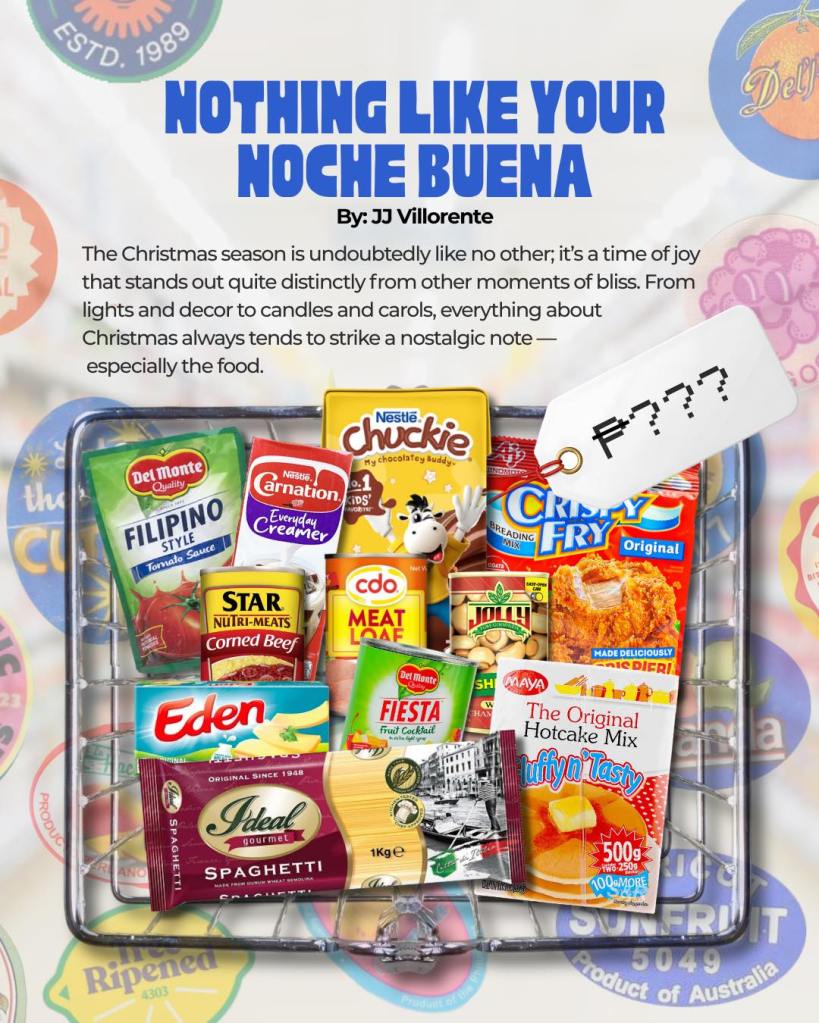
By JJ Villorente
The Christmas season is undoubtedly like no other; it’s a time of joy that stands out quite distinctly from other moments of bliss. From lights and decor to candles and carols, everything about Christmas always tends to strike a nostalgic note — especially the food.
Best known as Noche Buena, families typically celebrate Christmas Eve with a feast of their own, a banquet of delicacies able to feed more than everyone in the family. With some meals even being known for their seasonal servings, festive food becomes non-negotiable every Pasko season.
It’s only a shame that such merriment seems to be exclusive to Filipinos who can afford it.
Knowing that Christmas comes with its own celebratory standards, we are brought to look back at how marginalized communities share in the season’s festivities. What is the norm for some may be a luxury for many — and in the essence of this axiom, the reality of Philippine society cannot be encapsulated more truly.
Far From Fair
In a press conference held last November 28, Department of Trade and Industry’s (DTI) Trade Secretary Maria Cristina Aldeguer-Roque claimed that PHP 500 was enough to afford a complete Noche Buena for a family of four — a remark that later came to garner a whirlwind of scrutiny online.
With clarification after clarification, netizens did not hesitate to slam Roque’s suggestion, dissecting it piece by piece as media critics. It became such a spectacle that some even took her claim up a notch with the “PHP 500 Noche Buena Challenge,” in which they would attempt to purchase Noche Buena ingredients with a budget of PHP500. They proved to be the experimenters of Roque’s hypothesis — yet underlying this lighthearted challenge is the reality of financial hardship being confronted by a majority of Filipinos.
In short, PHP 500 is barely enough to fulfill the ideal Noche Buena.
As if tainted by a shadow of struggle and disparity, the season of cheer comes as a burden to those barely hanging on, counting simple blessings as they attempt to make ends meet. The expectation of a Noche Buena that overfills stomachs and satisfies appetites isn’t one that can easily be met by the marginalized population.
Additionally, this situation also drew flak from political figures — most notably coming from Vice President Sara Duterte, who rejected such a claim in an interview. It did not fail to garner comments deeming it “out-of-touch” and “unrealistic,” coming with the fact that this generalization poses a discrepancy when placed against the struggle depicted by reality.
While it is true that prices of certain goods may have stagnated throughout the year as per the DTI, it can also be said that most of the Filipino population still face economic burden. Millions of Filipino workers grapple with earning minimum wage, enabling them to cope with what little they have to spare for themselves, and in the holiday season, such situations only beget the difficulty of fulfilling the quintessential Noche Buena for the whole family.
Alongside this, poverty also remains a pervasive issue in the country, with millions of Filipino families living under the poverty threshold and getting by with very little. A survey by the Social Weather Station (SWS) conducted in September concluded that half of Filipinos considered themselves poor, illustrating the continuing prevalence of this issue in Philippine society.
This spectacle also piggybacks upon the fact that corruption still thrives within government walls, most notably manifested in the flood control scandal that continues to plague the country and its economy by subverting public trust and undermining societal stability. In this sense, Roque’s claim merely compounds the “out-of-touch” aura radiated by practitioners of corrupt governance, thus perpetuating a culture of inequality for low-income families.
What this ultimately insinuates is a stark disparity between fact and claim, characterized by an oversimplification painted against a backdrop of overlooked suffering. This becomes the essence of what many perceive Roque’s claim to be — with the bliss of Christmas only adding to the irony of the whole situation.
To Settle for Less?
Being well-aware of the fact that Roque’s generalization oversimplifies the issue of poverty and corruption, defenders of the PHP 500 Noche Buena somehow seem to subscribe to a more disturbing way of thinking — the mindset of learning to settle for less.
Strongly proven by all the vloggers who attempted the viral challenge, the PHP 500 Noche Buena has already been established to be vastly insufficient, yet with the presence of those who endorse this suggestion, there seems to be a sort of propaganda encouraging the masses to tolerate what little they may have, supporting a measly meal under the pretense of it “being enough,” when we know people deserve more.
Leaning into this idea is dangerous, for it represents us accepting the reality of Philippine poverty, coping with what little many may possess, instead of challenging the status quo. DTI choosing to perpetuate this tolerance in lieu of endorsing amends speaks volumes about our country’s governance, and in exchange, the masses suffer from not only poverty and financial insecurity, but poor authority as well.
With corrupt figures on the loose, turning a blind eye to the issues at stake, it simply becomes second nature to expect that injustice is perennial and inextricably tied to our nation’s essence. It becomes easier to think that such ways of life are the “norm” — when what we really should be doing is advocating for the right change.
The Challenge of Change
As Christmas comes to deck our halls, we are reminded not only of this year’s tidings and cheer — but of the reality being confronted by our nation at present. Witnessing government agencies feign optimism by overlooking root issues must rattle us to the core and thus prompt us to advocate for justice in our society.
Refusing to recognize an apparent issue in hopes of inculcating positivity and thanksgiving is a far cry from what Christmas teaches us to cultivate — love and peace. The festivities must then serve not as a distraction, but as a reminder of those who may not be as fortunate as to celebrate with a simple meal.
In the spirit of togetherness, acknowledging the challenges of our brothers and sisters shall ultimately be the backbone of a collective stint towards change — a change that does not solely bandage the cracks, but mend them in their entirety.
 HiLites ASHS