
By Tandang Sora
Tensions between the Ateneo Employees and Workers Union (AEWU) and Ateneo de Manila University began with the Work Rotation Program (WRP). In the university’s words, it is a “developmental and capacity-building initiative” that aims to strengthen “workforce flexibility and career growth.” However, such negotiations between Ateneo and the AEWU did not pan out smoothly.
Prior to the implementation of the WRP, discussions between the University administration and the union were already marked by conflicting perspectives on labor policies. Previous disputes have resulted in concerns over employee rights and welfare. However, negotiation and effective cooperation between the two parties remain prioritized. The established 2024–2029 Collective Bargaining Agreement (CBA) is evidence of this, ensuring mutual commitments to labor protections and institutional stability. Labor unions, in this way, act as both bargaining entities and workplace safeguards. In university settings, where labor stability directly affects educational operations, such functions take heightened importance.
The AEWU is a labor union representing the non-academic staff (maintenance and technical) employed at Ateneo de Manila University. Many of these staff are essential to the smooth operations of the University; they ensure that campus facilities remain functional and that daily services for students are consistently delivered. The presence of a union ensures that these staff are heard collectively and addressed systematically, becoming especially more prominent when significant alterations are made. As such, any points of contention between the Ateneo and AEWU have significant implications for the broader Ateneo community.
Root of the Issue
The WRP was to be implemented in the Housekeeping Services Section (HSS) of the Custodial Services Group. It involves the rotation of housekeeping personnel across different divisions — the grade school, high school, and college divisions — in the efforts of improving work performance and maintaining efficiency.
However, the production of the WRP was where the AEWU found an issue. According to AEWU President Raymond Tano, the Union officers were excluded from the policy-making and consultation process and were instead presented with the WRP as a finished product. This later came to be one of the Union’s grounds for its strike. This is one of the main matters of dispute, which begs the question of where managerial prerogative and worker participation end and meet.
Later meetings between the University and AEWU officers ended with the latter agreeing to the arrangement of the WRP, albeit “under protest.” Additional meetings were arranged with the administrators of the HSS and Central Facilities and Management Office (CFMO). The University emphasizes, in its position paper, that all agreements and acknowledgements took place before the day of implementation.
September 9, 2024 — the day that the WRP went into effect — saw several immediate issues. Fifty-one HSS personnel refused to comply with the program. Days before, a number of AEWU members also held unauthorized, non-work-related meetings during work hours. However, Tano maintains that these gatherings were work-related as they consisted of members asking for guidance in relation to the WRP. These instances of noncompliance mark a turning point in the labor conflict; the tension ended up escalating from policy disagreements to a formal labor dispute. In turn, these developments following the implementation of the WRP led to disciplinary action by Ateneo de Manila University.
Aftermath of the WRP
The University distributed Notices of Charge (NOC) based on two aforementioned incidents: the unauthorized, allegedly non-work-related assemblies and refusal to abide by the conditions of the WRP. After following due process, 30 were charged for the unauthorized meeting, and 51 were found guilty of insubordination and willful disobedience. Tano claims, however, that the University’s proof, which consisted of CCTV footage, lacked sufficient context to be able to become the basis of the imposition of disciplinary sanctions. He also added that these suspensions, especially those against Union officers, were retaliatory and constituted unfair labor practices. Based on Tano’s previous statements, Ateneo’s charges related to the gatherings lacked an accurate basis and sufficient evidence.
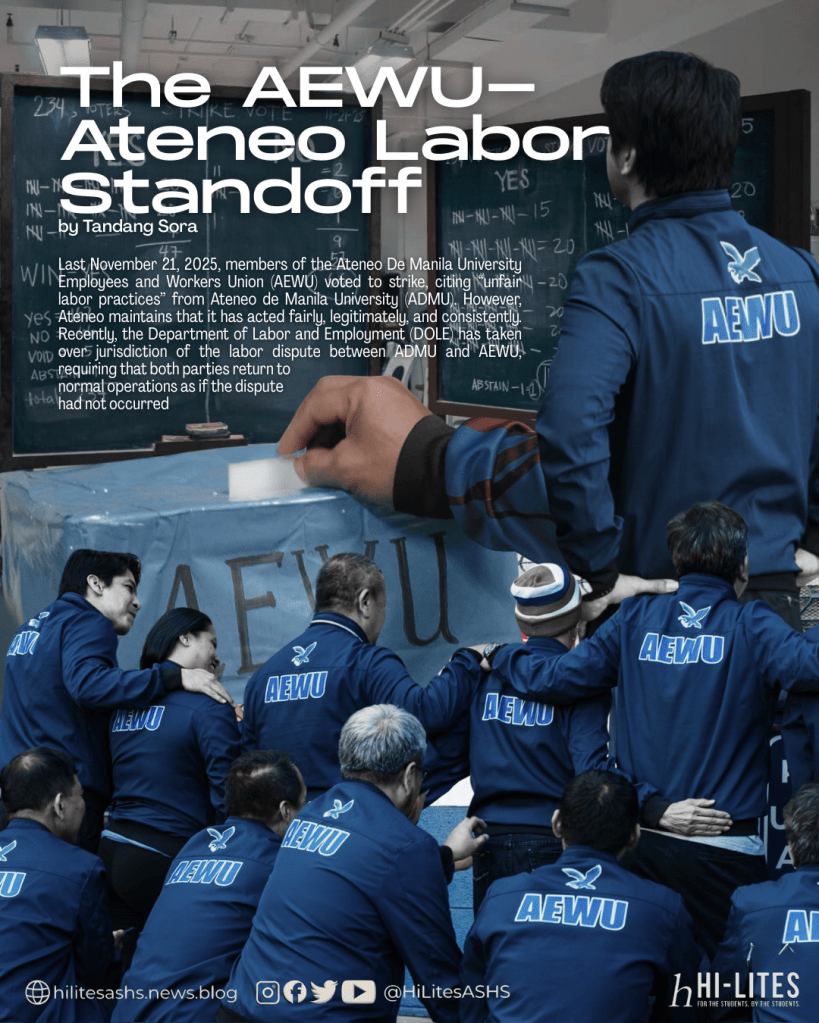
This culminated in the Notice of Strike filed by the AEWU with the Department of Labor and Employment (DOLE) on November 21, 2025. 162 out of 234 members voted in favor of the strike on the basis of alleged unfair labor practices, thereby satisfying the statutory requirement for a valid strike vote and formally escalating the dispute.
The National Conciliation and Mediation Board (NCMB) acted as a mediator between the University and the Union as the three parties began conciliation proceedings. With this, following a 7-day cooling-off period as defined in Section 6 of the Manual of Procedures in the Settlement and Disposition of Conciliation and Preventive Mediation Cases, the earliest date for a strike would be on December 2, 2025.
Disciplinary measures imposed as a result of labor conflicts, as seen by the Union’s decision to strike, carry workplace-wide implications beyond individual discipline. Unions often use these occurrences as a way to interpret administrative tolerance for collective cause. Thus, it ended up being central to the unfair labor practices allegations.
Assessment of AEWU and Ateneo’s CBA
AEWU cited the following grounds for its strike: a) violation of CBA; b) indiscriminate issuance of charges; c) violation of CBA provision on company policy-making; d) baseless suspension; e) baseless charges against Union president and officers; f) harassment; g) abuse of authority of superior; and h) imposing suspension to almost 70 Union members, including officers, for baseless and indiscriminate charges. In order to understand what constitutes a “violation of CBA,” it is important to examine whether the University breached the conditions expressly agreed upon in the collective bargaining agreement.
The following were defined as the prerogatives/functions of the University:
- To select, hire, assign and retain its employees in jobs within the University;
- To train, direct and schedule the work force;
- To determine, establish or modify rules and regulations for the orderly and efficient work performance of its employees, and to maintain performance standards for all types of work;
- To maintain discipline and efficiency among its employees;
- To promote, transfer, suspend, dismiss for cause, or relieve the workforce from their duties due to lack of work or for other legitimate reasons;
- To reduce or change the composition of the work force, if in its sole judgment this action is required;
- To adopt, install or operate new or improved equipment or work methods;
- To grant leaves of absence and other employee benefits, determine employee classification and any pay increases;
- To practice the usual prerogatives/functions of the Administration in operating the University.
Likewise, it should also be noted that the Administration “recognizes that the Union shall participate in decision and policy-making processes affecting their rights, benefits, health and welfare for as long as this participation does not infringe on the prerogatives/functions of the Administration.”
These statements reveal possible points of contention through which the grounds for Notice of Strike were filed. While Ateneo claimed the WRP was implemented with the agreement of Union officers, Tano argued otherwise. As previously mentioned, he claimed that the University did not involve Union officers in the policymaking process, which could have constituted a violation of the CBA term that the “Union shall participate in decision and policy-making processes affecting their rights, benefits, health and welfare.” However, the University maintains that it was acting within its aforementioned prerogatives/functions in the drafting and implementation of the WRP. While CBAs are precisely designed to mediate tension between Administrations and Unions, they can sometimes become rifts that reveal ambiguities and exacerbate conflict. These differences can reveal a fundamental misunderstanding between the two parties of the labor partnership itself.
DOLE’s Interference
On December 2, 2025, DOLE issued an Order Assuming Jurisdiction over the labor dispute between Ateneo and AEWU, placing it under their jurisdiction. Following this, it prohibited the actual implementation of the planned strike.
The order directed both parties to maintain the status quo and to cease and desist from any actions that may disrupt the continuity of proceedings, and that may aggravate the dispute any further. During this time, DOLE continues to investigate under compulsory arbitration with the guidance of its Secretary. State intervention shows that labor conflicts are not only significant within the workplace itself but also through a general scheme of public labor governance, especially for national labor regulation bodies such as DOLE.
As of the time of this article’s publication, no definite resolution has been made. DOLE’s investigation appears to remain ongoing, with both parties awaiting formal directives that would determine the validity of the alleged unfair labor practices and the propriety of the disciplinary actions taken by the University. Nonetheless, the pending investigation has left both parties at an impasse, with day-to-day operations carrying on as normal despite the unresolved conflict.
In Light of the Above
Taken all together, the labor dispute between the AEWU and ADMU reflects a breakdown in labor-management relations due to a general lack of dialogue. Despite conciliation efforts and DOLE’s assumption of jurisdiction, the conflict and consequently tension have remained unresolved.
These developments have likely eroded relations on both sides. The unilateral implementation of the WRP and the subsequent disciplinary measures coincided with the Union’s filing of unfair labor practices. The refusal of employees to comply with the program may have become a cause for heightened tensions. The longer the conflict goes unresolved, the more uncertain the consequences — prolonged uncertainty due to the unresolved conflict carries the potential to threaten workplace morale, stability, and labor relations.
Overall, the dispute emphasizes the fact that both the Administration and the Union carry responsibilities in the face of labor conflicts. These two parties operate reciprocally for the sake of maintaining fair labor relations. Management action must be rooted in responsible and fair communication, while union action must remain grounded in reasonable and constructive negotiation. From this dispute, it is seen that labor relations remain reliant on dialogue, mutual recognition, and the willingness of both parties to reach a genuine resolution.
 HiLites ASHS