
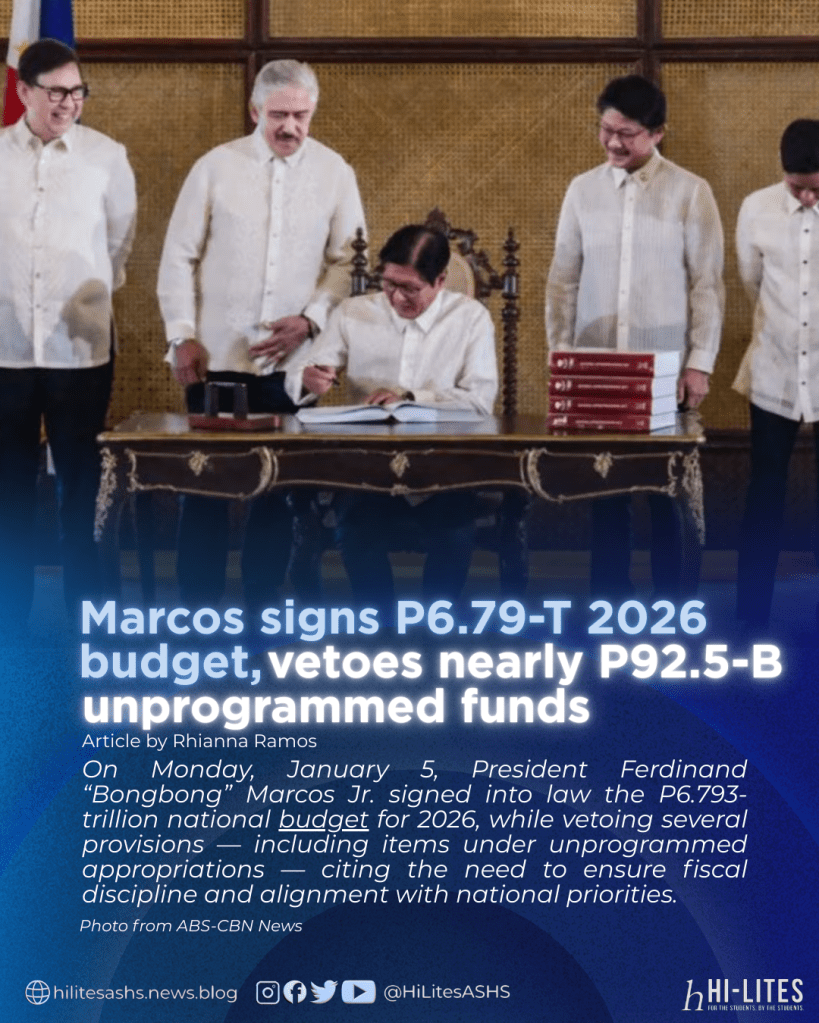
From ABS-CBN News
By Rhianna Ramos
On Monday, January 5, President Ferdinand “Bongbong” Marcos Jr. signed into law the P6.793-trillion national budget for 2026, while vetoing several provisions — including items under unprogrammed appropriations — citing the need to ensure fiscal discipline and alignment with national priorities.
The 2026 General Appropriations Act (GAA) is the largest national budget to date, with allocations focused on education, health, social services, agriculture, and infrastructure, according to Malacañang.
During the signing ceremony, Marcos described the spending plan as people-oriented and stressed that the government is committed to “a budget that serves the people.”
Furthermore, he addressed concerns over unprogrammed appropriations, clarifying that these funds “are not blank checks” and may only be accessed once safeguards are met and clearly defined conditions are followed.
The Department of Budget and Management (DBM) said education received P1.345 trillion, equivalent to 4.36 percent of the country’s gross domestic product (GDP).
This will fund thousands of teaching and non-teaching positions and the construction of nearly 25,000 classrooms nationwide.
Meanwhile, the health sector’s budget allocation was set at its highest level to date at P448.125 billion to support universal health care, disease prevention programs, and the hiring of additional medical personnel.
Other sector allocations include P297.102 billion for agriculture, P270.18 billion for social services, and P15.33 billion for disaster rehabilitation efforts.
The approved budget was transmitted to the Office of the President on December 29, 2025, following prolonged bicameral deliberations.
Explaining the review process, DBM Secretary Rolando Toledo said the Executive conducted a thorough and careful review of the budget to ensure consistency with the administration’s priorities and stakeholder recommendations.
Marcos vetoed select items under unprogrammed appropriations, retaining only funding for foreign-assisted projects, the Program on Risk Management, and the Revised Armed Forces of the Philippines Modernization Program.
Expounding on the decision, he said the vetoes were made to ensure public funds are spent “in clear service of national interests.”
He further directed government agencies to monitor spending implementation, calling for accountability.
Marcos emphasized that agencies must “exercise prudent fiscal management” and ensure uninterrupted public service, adding that citizen participation and oversight remain critical in safeguarding public funds.
 HiLites ASHS