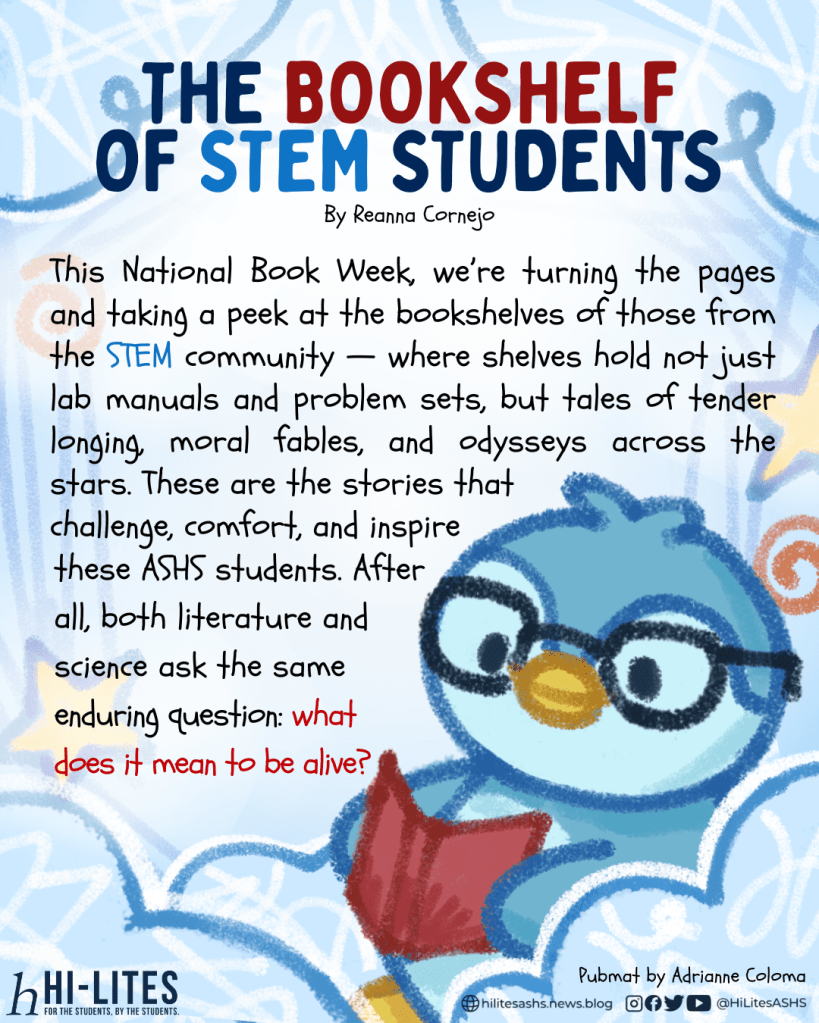
By Adrianne Coloma
By Reanna Cornejo
Contrary to the long-standing stereotype that STEM students live solely between equations and diagrams, their bookshelves don’t just hold rows of lab manuals and problem sets. If you peeked into a STEM student’s bookshelf, you’ll actually find books beyond formulas — readers drawn to aching romances, philosophical parables, and interstellar survival stories. Literature invites us to explore not only the outer limits of knowledge but the inner contours of the human experience. This National Book Week, some of the Ateneo Senior High School’s students are here to share the stories that have expanded their curiosity, challenged their thinking, and tugged at their emotions.
Nights of Love and Loneliness
On Lucas Villasenor’s shelf from 12-Navarro sits “White Nights” by Fyodor Dostoevsky, an 1848 psychological fiction novella whose simplicity belies its elegance. At first glance, it may seem like a simple tale of romance, but as Villasenor explains, its beauty lies in that exact simplicity. “I wish I’d read this book sooner,” he says. “Its plot is straightforward, yet its eloquence and emotional depth are unforgettable.”“White Nights” follows a lonely, introspective, unnamed man called “the dreamer” who walks the streets of St. Petersburg at night. On one particular night, he encounters Nastenka, a young woman in distress. Over the course of four nights, Nastenska and the dreamer develop a delicate friendship, sharing hopes, dreams, and confessions. Dostoevsky talks about loneliness, vulnerability, and fleeting joy, which are all feelings that resonate especially with the youth of today. However, it’s worth noting that Dostoevsky also explores heavier themes that may not be accessible for everyone, including familial deaths, depictions of abuse, as well as implications of romantic relationships with significant age gaps.
Villasenor called relatability the hardest part to bear. To him, one line in particular encapsulates the entire story’s bittersweet resonance: “You mustn’t fall in love with me.” He reflects on how this line showcases Dostoevsky’s ability to capture love in its rawness: the vulnerability it takes in opening oneself to another and the way it can blind and illuminate all at once. Dostoevsky’s writing style reads like a conversation in the heart of St. Petersburg, where loneliness and hope meet under streetlamps. “This book changed my perspective of love so much that I started to reflect on what it truly means to me,” he says. On his bookshelf, alongside textbooks and lab reports, “White Nights” is a reminder of the beauty of fickle human connection and how it is often the simplest moments that are the most profound.
Childhood Wonder and Moral Reflections
Jay Tacason from 11-Perez wants to bring attention to a story that celebrates curiosity and innocence in a new way. He recommends “The Return of the Young Prince” by A.G. Rommers, a fanmade tribute to Antoine de Saint-Exupéry’s classic, where the book imagines what happens when the Little Prince returns to Earth years later. While Tacason recommends the original just as highly, this continuation holds a special place for readers who once saw themselves in the Little Prince’s iconic wide-eyed wonder.Like its predecessor, the book reminds us that maturity does not require the death of curiosity. In a world that often markets cynicism as simply wisdom, “The Return of the Young Prince” encourages readers to question norms, hold onto empathy and imagination, and to allow yourself to stay soft in a hardening world. “Despite how much more you think you know about the negativity of the world, it’s always worth keeping alive that sense of wonder,” Tacason reflects. The book acts as a gentle companion for anyone navigating the tricky path between childhood and adulthood, and for Tacason, it offered clarity. It reassured him that even as we grow older, we are still allowed to be the children we once were. “It helped me navigate my confusing teenage years and inspired me to approach life’s long journey with an open heart and mind,” he adds. This story, amongst his academically demanding routines, sits like a bright bookmark of joy and reflection, encouraging all who read it to keep questioning and to keep dreaming.
Survival Amongst the Stars
And then there’s Moira Gregorio from 11-Moscoso, whose bookshelf holds a special place for “Project Hail Mary” by Andy Weir, a science fiction adventure published in 2021 that proves STEM narratives can be both intellectually stimulating and emotionally packed.
The story begins with a man who wakes up alone aboard a spaceship, with no memory of who he is or why he’s there. As the book progresses, the man gradually begins piecing together not only his identity and the essence of who he is, but a mission and purpose far bigger than himself. Along the way, he encounters an alien life form with which he forms a unique and unexpected bond, weaving humanity into a story teeming with high-stakes science. “It was the first science fiction book I read, and it’s unlike anything else I’ve experienced,” Gregorio says.
Andy Weir, who also wrote The Martian, includes explanations of physics, biology, and engineering, but weaves them naturally into the story so readers don’t feel lost. Despite its scientific backbone, Gregorio emphasizes that “Project Hail Mary” remains accessible and engaging. The explanations are clear, the pacing immersive, and the experience of reading itself unforgettable. She believes that past the star charts lies a story about connection and courage, even across the vastness of space. “It’s not just for ‘nerds,’” she laughs, “it’s such a unique, immersive experience.” On her bookshelf, this book proves that the pursuit of knowledge is not confined to experiments: it can be found in every page turned with wonder.
Reading as Scientific Thought
The bookshelf of STEM students, then, is not just a collection of textbooks and formulas. It is a reflection of hearts that feel deeply and spirits that never stop questioning. From Dostoevsky’s night-time contemplations, to the whimsical lessons of a prince who never truly grows up, to the odyssey of a lone astronaut in the race to save humanity, these chosen books show that STEM minds are never confined to logic alone — they dream, they wonder, they feel. And through books, we are reminded that logic can also thrive in stories and imagination. After all, whether through books or formulas, both literature and science ask the same enduring question: what does it mean to be alive?
 HiLites ASHS