
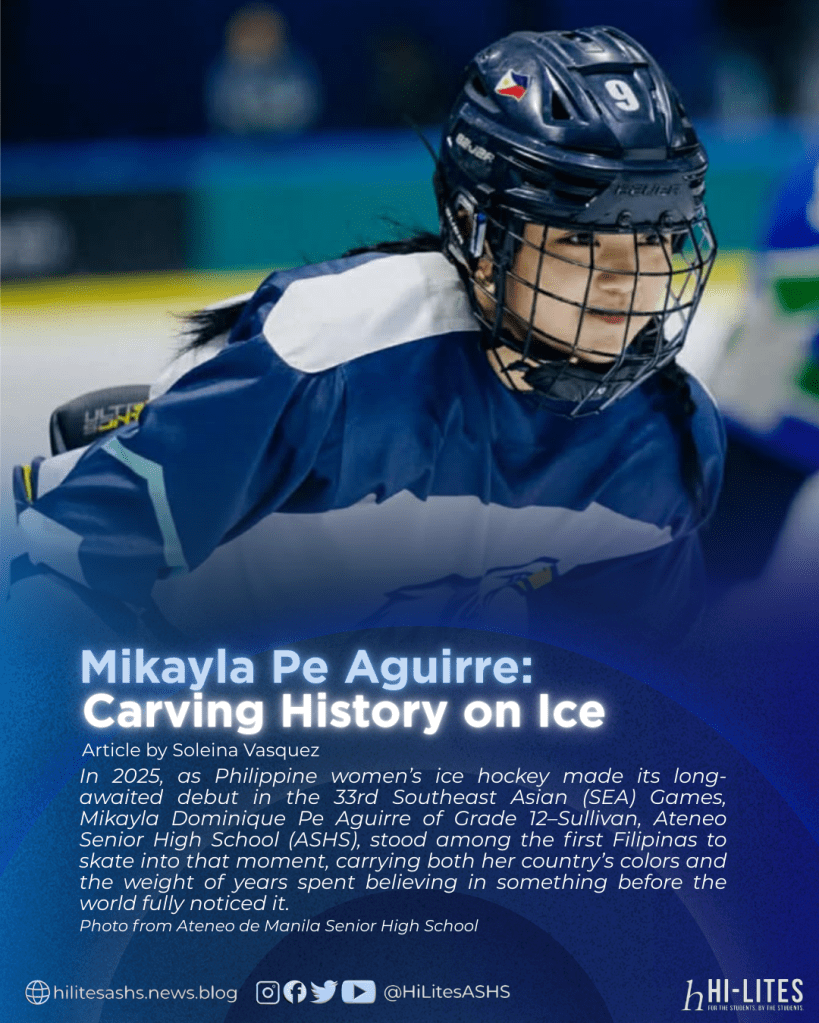
From Ateneo de Manila Senior High School
By Soleina Vasquez
The rink is decorated with slices at night. Fluorescent lights hum softly above the frozen surface, casting long reflections that shimmer like spilled moonlight across the ice. Long after classrooms have emptied and mall corridors have gone dark, the rink stays awake cradling the passion of those who return again and again.
For Mikayla Dominique Pe Aguirre of Grade 12–Sullivan, Ateneo Senior High School (ASHS), the ice has never been just ice. It has been a second classroom where lessons are learned through bruises and breathless laps, a proving ground where challenges are confronted head-on, and eventually, a threshold to history. In 2025, as Philippine women’s ice hockey made its long-awaited debut in the 33rd Southeast Asian (SEA) Games, Mikayla stood among the first Filipinas to skate into that moment, carrying both her country’s colors and the weight of years spent believing in something before the world fully noticed it.
When Mikayla stepped onto the SEA Games stage as a forward of the pioneering Philippine women’s ice hockey team, she did not arrive there suddenly. She arrived carrying years of unseen labor, of balancing exams with evening practices, of choosing to commit when rest felt easier, of growing into both a student and a national athlete at the same time.
The SEA Games ended with the clock expired, but not the story. When the ice settled, the Philippine women’s ice hockey team stood silver-bright, their finish catching the light like frost at dawn — gleaming and earned. Soon after, that silver would shine beyond the rink.
Alongside the country’s ice skating and speed skating medalists, Mikayla and her teammates were welcomed at “A Day of Champions” in Pasay City, where applause rewarded the scrape of blades and victories were declared aloud.
For a sport that once lived in the margins of midnight practices, the recognition feels almost magical — proof that even the coldest and unreachable dreams can light on fire.
It Began Without a Map
Her story did not begin with medals in mind, nor with dreams of international competitions. It began during the pandemic, when curiosity filled the spaces left by a world at pause. “My journey in ice hockey began during the pandemic, when I decided to try using my brother’s old rollerblades. I taught myself basic tricks through YouTube, then became obsessed with learning jumps and spins after watching figure skater Alexandra Trusova.”
What started as experimentation soon deepened into fascination. When skating rinks reopened, Mikayla returned to the ice with no expectations beyond enjoyment. That was when a figure skating coach noticed her teaching herself elements and decided to take a chance on her. As she recalled, “With her, I spent the next two years training and competing in local figure skating events.”
Those early years taught her structure and control, but also awakened a hunger for something more demanding — something faster, louder, and less predictable.
Choosing the Bigger Game
Hockey entered Mikayla’s life not as a carefully planned transition, but as a subtle pull she could not ignore. Watching practices, she was drawn to the speed and intensity of the sport, to the way it demanded full presence from everyone on the ice. “Watching the speed, physicality, and intensity of hockey made me fall in love with the sport,” she said.
At the time, the environment was unfamiliar. There were no girls in the club, no clear blueprint to follow. Still, she stepped forward, asking for space in a room where she was not yet represented. “Though there were no girls in the club, I decided to take a chance and ask if I could train with them anyway and was fortunate to be welcomed by the team.”
That welcome came with challenges. Training alongside boys who were older and physically stronger forced her to grow quickly, sharpening both her skill and her confidence. “Training with boys who were older and bigger was difficult and intimidating, but I believe it’s one of the reasons I progressed so fast.”
Soon, hockey demanded more than interest — it demanded her time. Practices multiplied. Commutes stretched. “I became so obsessed with the sport to the point that I was on the ice almost every day, regularly travelling from Quezon City to MOA just to train.” What once felt like curiosity transformed into routine, then into sacrifice.
After two years, her persistence caught the attention of the national team coach. She was invited into the national women’s team training pool, and over time, earned a permanent spot — even occasionally starting games despite being the youngest and least experienced.
Yet her reasons for staying remained simple and deeply personal. “I never set out aiming for the SEA Games or any international competition. I played simply because I loved the sport and wanted to challenge the stereotype that hockey was ‘for boys.’”
A Student in a Big League
Living as both a student and a national athlete required learning how to stretch time until it nearly disappeared. Sleep became fragmented, and rest was often postponed. National team training frequently began when most people were already winding down. “National team training is held when the mall closes at 10 p.m., often ending at around 12 a.m.,” she shared. With the long commute, returning home at 1 a.m. became routine.
Academic life did not slow to accommodate training. Assignments waited patiently, quizzes arrived regardless of exhaustion, and absences accumulated as competitions demanded her presence. “Pushing out work in that weird period between 1 a.m. and my 5 a.m. wake-up time is a real challenge,” she admitted, especially when fatigue weighed heavily on her body.
Still, she pushed forward. “I take lots of absences to join competitions, and it can be hard to find time to learn the lessons I’ve missed on my own and finish tasks,” she said, before adding without hesitation, “But I wouldn’t trade the experience of competing for anything!”
When the announcement came that women’s ice hockey would officially be included in the SEA Games, disbelief arrived before celebration. The reality took time to settle. “It took days for the news to sink in that our team was actually going to the SEA Games.”
The moment pulled her back through memory — toward nights spent fighting for ice time, toward early days when opportunities felt scarce. She remembered the sacrifices clearly: “I remembered the nights I sacrificed sleep to train, even before exams, the weekends I gave up, the parties and hangouts I skipped, and all the exhaustion I pushed through just to stay on the ice.”
But standing on that SEA Games stage felt like more than personal achievement. “Being part of the pioneering SEA Games women’s hockey team felt like the culmination of all those sacrifices, not just mine but everyone’s.”
This time, wearing the Philippine colors carried a different weight. “We weren’t just carrying the flag, we were carrying decades of effort poured into keeping this sport alive,” she reflected. “It was a heavy burden, but also the most meaningful one I’ve ever carried.”
What the Ice Streaks Show
The SEA Games demanded more than physical readiness, as they tested emotional and mental strength, discipline, and maturity — especially for a student balancing school and national expectations. “The hardest part was giving up my time,” Mikayla admitted, recalling nights when rest and study both felt out of reach.
There were moments when pressure came from every direction — academics, teammates, and the constant need to prove she belonged. Some struggles remained invisible: injuries managed, doubts wrestled with internally, emotions steadied beneath a helmet and visor.
Yet through it all, the ice continued to teach and stand strong with her. It taught her that growth is rarely loud, that progress often happens when you are alone in a room. She credits the sport’s steady rise to a community that refused to let it fade. “Ice hockey has grown in the Philippines because of its fiercely dedicated community,” she said, acknowledging the players, coaches, and families who showed up year after year.
More than medals, she hopes the SEA Games experience leaves a message. “I hope our SEA Games experience shows that Filipino athletes don’t need perfect conditions or traditional pathways to excel,” she shared. “Even in a tropical country with no natural ice, we’ve proven that persistence can open doors to sports and opportunities that seem out of reach.”
Mikayla’s journey lingers beyond the rink. It is a reminder that a student can stand in a big league, that ambition does not have to wait, and that history often begins quietly — with borrowed rollerblades, late-night practices, and the simple decision to keep showing up.
 HiLites ASHS