From Rappler
By Noriko Yamamoto
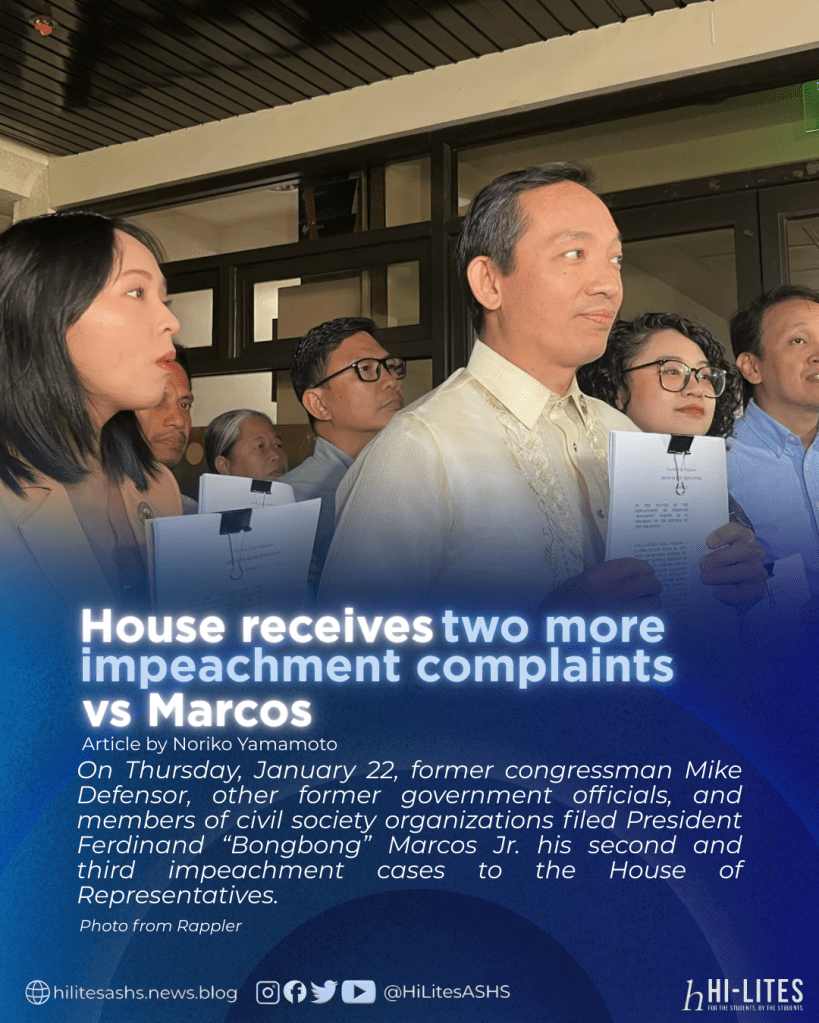
On Thursday, January 22, former congressman Mike Defensor, other former government officials, and members of civil society organizations filed President Ferdinand “Bongbong” Marcos Jr. his second and third impeachment cases to the House of Representatives.
Marcos’ Second Impeachment Case
Marcos’ second impeachment case for betraying public trust was endorsed by Macabayan bloc congressmen.
The complaint against him outlined three articles, accusing him of institutionalizing systemic corruption through the so‑called “BBM Parametric Formula,” which allegedly entrenched a pork barrel system that prioritized political patronage over technical and community needs, resulting in massive fund misallocation and alleged kickbacks for favored officials.
It further charged that Marcos abused discretionary authority over unprogrammed appropriations (UA) by authorizing their release in ways that allegedly bypassed congressional oversight and turned the UA into a vehicle for plunder.
The third article claimed direct presidential involvement in budgetary insertions and kickback schemes, citing former House Appropriations Chair Zaldy Co’s statement in a social media video that Marcos personally ordered the insertion of P100 billion in the 2025 budget for questionable projects.
Supporting evidence included sworn affidavits from former Department of Public Work and Highways (DPWH) Undersecretary Roberto Bernardo, the Cabral files, and transcripts from Senate Blue Ribbon Committee hearings.
However, the office of House Secretary General Cheloy Garafil rejected this request as she was not present during the time.
With this, Executive Director of the House Secretary General’s Office informed complainants Atty. Neri Colmenares and Teddy Casiño that he did not have the authority to accept the complaint.
Complainants and endorsers of the second impeachment complaint then argued that House rules only require filing with the Secretary General’s office — therefore leaving a copy in Garafil’s office and declaring it officially filed.
“Nakakadismaya na ayaw tanggapin ng Executive Director ng Secretary General’s office ‘yung complaint,” Casiño said.
“Ang sabi namin, under the rules, ang complaint ay dapat fina-file sa Office of the Secretary General at hindi nagre-require ng presence ng Secretary General mismo para ito ay simpleng — in a ministerial manner — tanggapin ng kan’yang opisina,” he added.
He further explained that the absence of the Secretary General was not their fault, and that their submission to Garafil’s office is sufficient as per the constitution’s rules.
“Para sa amin, that impeachment complaint is deemed filed … Kami ang sumunod sa Rules of the House, at kung hindi susundin ng House ang sarili nilang Rules, hindi dapat burden ‘yan sa mga impeachment complainant,” Colmenares asserted.
Complainants and supporters of the second impeachment case visited House Speaker Faustino “Bojie” Dy III’s office to urge him to include their petition in the chamber’s agenda.
Liza Maza, one of the complainants, warned that blocking the second case might signal a plan to pursue only the initial impeachment complaint against Marcos, which she criticized as “weak.”
Complainants stressed that Filipinos deserve a leader who serves the Constitution, safeguards public funds, and upholds trust — not one who subverts, plunders, or betrays it.
Marcos’ third impeachment case
Later the same day, Marcos’ third impeachment case was filed due to allegations that he profited from the ghost flood-control project.
Moreover, with Garafil’s absence, Defensor branded the refusal to accept the impeachment complaint as a violation of both House Rules and the 1987 Constitution.
He emphasized that the Rules impose a ministerial duty on the Secretary General to receive and record duly filed complaints, with “no discretion to reject, screen, delay or block such filings.”
“By refusing to accept the complaint, the Office effectively usurps the constitutional authority of the House itself and denies the Filipino people their only lawful mechanism to raise grievances against a sitting President,” Defensor declared.
With this, Defensor stated that he would not go back to the House to file the complaint as he was weighing alternative legal remedies such as elevating the matter to the Supreme Court.
 HiLites ASHS