
By Feebee Mariposa
By Gilli Aquino
What does it mean to be a storyteller?
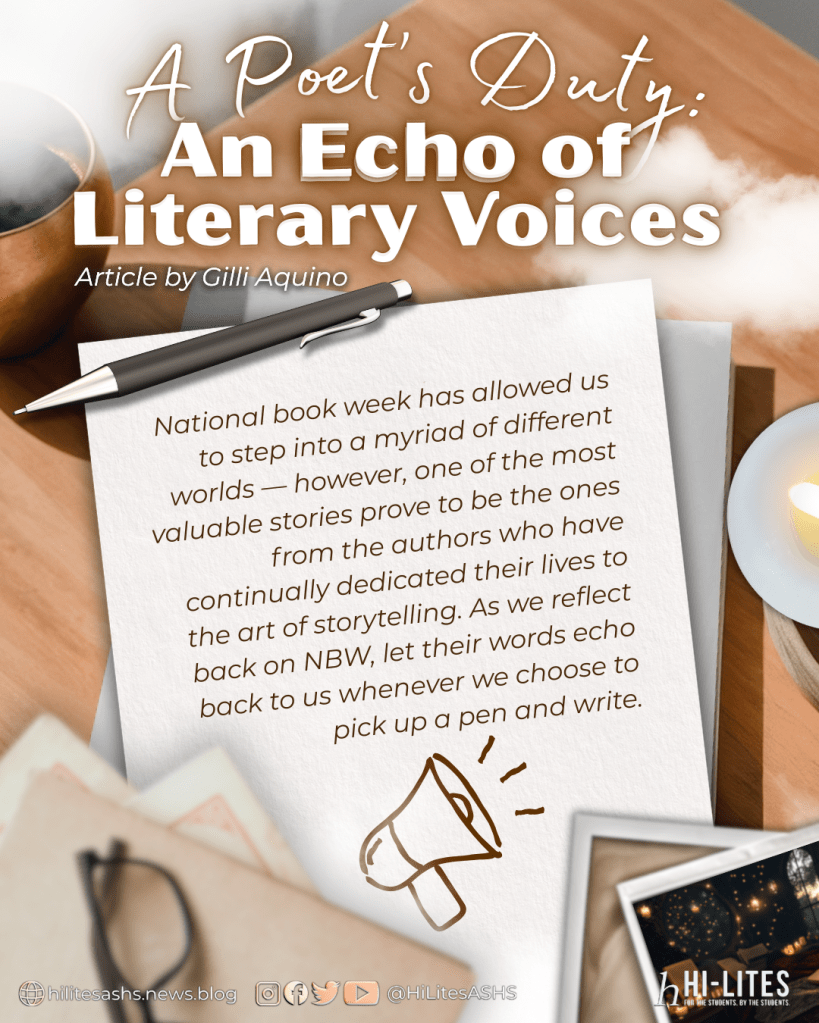
There is a unique responsibility that comes with being a writer — to use your pen as a tool to echo the stories that are so often not shared. Each carefully chosen word or crafted line is a thought let loose by a writer who is screaming for their voice to be heard. Whether through stories of magic or beautifully written prose, those who choose to read between the lines will find themselves with a plethora of secret messages.
In line with National Book Week (NBW), the ASHS community was graciously given the opportunity to learn more about the world of creative writing. Invited speakers Dr. Christine V. Lao and Norman Boquerin happily shared their valuable insights with the student community; their sentiments inspired those young students who one day hope to hold the pen with the same fervor. As we reflect back on NBW, let us hold their words of wisdom close to us every time we choose to pick up a pen and write.
First Scribbles
“Letting language lead the way in my thinking.”
From the pre-colonial tradition of riddles and folk songs to the writings of Jose Rizal and Francisco Balagtas, poetry has undoubtedly always been a large part of Philippine culture. At the end of every verse and stanza is an avenue for self-expression that can only be satiated when pen meets paper. For Dr. Christine V. Lao, poetry is not only a way to express thoughts, but a political alternative to language so often misused.
Dr. Christine V. Lao is a lawyer, poet, and professor at U.P Diliman. She graduated from Ateneo de Manila University with a degree in AB Philosophy and continued her studies in law at UP Diliman. Dr. Lao has dabbled in the world of writing through columns in the Sunday Times Magazine and contributions to books on law. Most notably, she has published novels consisting of short stories and poems, such as her book “Musical Chairs,” a collection of Philippine fables, and her most recent book, “Affidavit of Loss,” an ensemble of poems that explore the terrifyingly beautiful power of language.
Dr. Lao’s love of poetry was first ignited when she came across the book entitled “Dark Hours” by Conchitina Cruz — a beautiful collection of pieces about a woman in the city. “This was the kind of treatment of language that I wanted to do when I was young, but I didn’t know how to do it,” she remarked on the writing style of Cruz. “To have found someone who had actually done it and was younger than me, and I didn’t know who she was, amazed me.” The works of Cruz have undoubtedly inspired the way that she writes today — ultimately leaving Dr. Lao with the question of how poetry can be so lyrical and political at the same time.
There are those few pieces of writing that leave us forever changed, for even the greatest of writers have had their start by simply choosing to open a book. Similarly to this, Norman Boquiren — a storyteller, playwright, and teacher — found his first inspirations in the story of “Noli Me Tangere.” Boquiren has published children’s books such as “Bumibilita,” “Ang Batang Papet,” “Ang Mahalagang Misyon ng Mga Batang Pekiro,” and many others. Aside from being a published author, Boquiren also teaches at U.P Diliman and is the current Artistic Director of the University of the East Drama Company.
The spark in his storytelling was found between the pages of Jose Rizal’s classic novel. Boquiren recalls when “Noli Me Tangere” was first discussed in the classroom — a discussion that triggered his interest in writing; every metaphor and hidden gem found between each line remains unforgettable for him. In line with his love for classics, Boquiren recommends Shakespearean plays as a good foundation for anyone interested in the world of theater. To him, you must know the basic law of theater before you are able to branch out and break it.
Protest Through Poetry
“It is a way of speaking not much appreciated but very powerful.”
Some would say that writing is the most sincere form of self-expression — to have every thought and feeling arranged in perfect prose. However, the one who holds the pen possesses the greatest responsibility for the impact that their words may have.
“When I was writing the poems, not all of them were written with politics in mind; they were really poems about the things that were in my mind,” Dr. Lao remarks on the thought process behind her latest book. As both a lawyer and a poet, she is often asked to reconcile herself to either one of these identities; however, in Dr. Lao’s perspective, one is never more than the other — they simply occupy the same space.
In fact, it is the language of law that helped lead her towards poetry. “I started thinking, what else is there that language can do? And I found my model in poetry,” she explains on her relationship with language. “When I read a haiku I feel less alone, even if I don’t understand it. There’s nothing to understand, but everything to feel; you feel like you belong there in that moment with someone.”
Poetry is often an underrated form of expression, chopped down to the dramatic Shakespearean tragedies that appear as complicated symbols for people to interpret. However, in the eyes of Dr. Lao and many other poets, poetry is a way of communicating every belief and advocacy without lecturing. In her own words: “The challenge then becomes how you express your politics in a way that doesn’t make someone feel angry or guilty, and feel instead that they should take a look at this thing more and try to see if there is more than just a simple feeling.”
For many storytellers, you write not merely for the sake of saying something but rather because the words you scribble down carry a weight that goes beyond self-expression. “Kailangan tingnan natin yung ginagawa nating bilang una contribution sa Philippine literature, pangalawa kailangan meron ka talagang sinasabi,” remarks Boquiren on the responsibility that comes with being artists. He expounds on the importance of art being political — not always in the sense of rallies and protests, but political expression from a personal place.
The art of poetry and politics are not necessarily the two opposing forces that most people believe them to be. There is beauty in the way that plays and poetry convey political words without the same anger and aggression often expressed.
Dear Writer
“Writing has always been about building and being with community”
For many, the hardest part of writing is simply choosing to begin —- to look at the blank page and choose to put the tip of your pencil on paper.
The ASHS community is filled with many young aspiring writers, however, venturing into the wild world of art and literature is intimidating for anyone no matter how skilled they may be. As a teacher himself, Boquein advises young artists to have patience with their work and not always look for instant gratification. In his own sentiments: “We don’t have to write for clout or praise, ang mga good works ay pinaghihurapan.” No matter how skilled or talented you may be, any great masterpiece takes time. Boquerin reminds us to keep reading, keep growing and above all else to keep yourself grounded.
As for Dr. Lao, to be a writer is to think of yourself as an entrepreneur. Many people today continue to underestimate the value of creative writing, therefore any young writer must continue to look out for themselves. “It’s easier to look out for yourself when you’re with a group of people,” Dr. Lao details on her advice for aspiring writers. These groups of people are those who are interested in the same passion for creating literature. “These could be your fellow writers, your publishing house, your editors, your “booktockers;” it takes a village to make a book.” For so long as you have a community that you love —- any type of book or art is possible.
Being a storyteller comes in many different forms. From the romance and grace of theater to the rhymes and lines of poetry —- art is forever limitless. Yet the best kinds of art are those with the power to graciously provoke not only feelings but an urge to understand. Not through the use of guilt or anger but through the words that allow you to feel everything and anything.
As NBW comes to an end, let us remember the words of these storytellers every time we choose to partake in the world of art. Whether it be a story that comes from our dreams or an entry in a journal, our words will never go to waste for so as long as we continue to let truth and love lead the way.
 HiLites ASHS