
By Feebee Mariposa
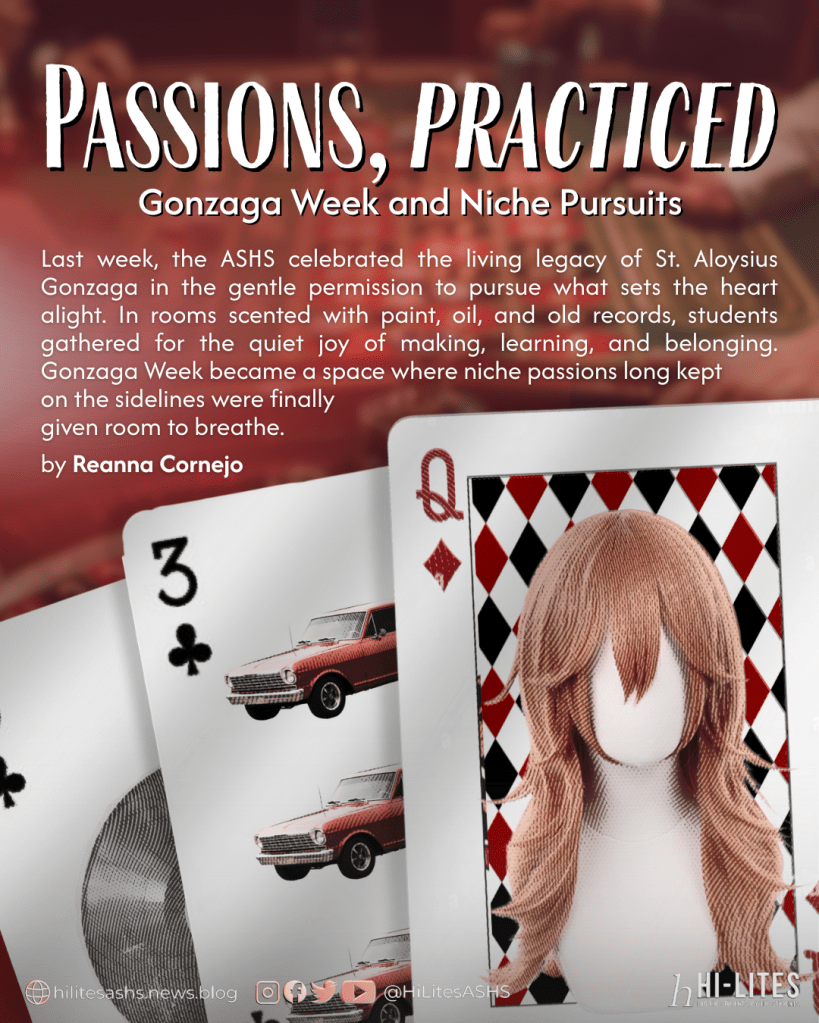
By Reanna Cornejo
Gonzaga Week at the Ateneo Senior High School is that rare breath in the academic year when the heart is invited, unabashedly, to beat in rhythms not just of routine but of passion. Where students drawn from every strand of the school’s mosaic gather to explore facets of themselves they might not yet have known. It is a week softened gently by the cadences of wonder; an annual celebration that honors the life and ideals of St. Aloysius Gonzaga — calling us to find God in all things, employ creativity that is as reflective as it is daring, and to walk boldly in our unique callings.
Amidst the alternative classes are the ones of niche pursuits, where passions too often relegated to the side are now given voice, space, and practice. In classrooms filled with tools, threads, and records, students are invited to stretch the sinews of creativity, to craft community with gestures as authentic as the pulse of their hearts. In a culture that prioritizes rigor and academic excellence, there is something almost sacramental about the freedom to choose how we learn, to pursue the kind of knowledge that is not required, but one that resonates in the body and soul.
Material Melodies
In the “Physical Music Media: Show, Tell” alternative class, students were invited to honor the tactile ritual that only physical media can conjure: the weight of a vinyl record in one’s palms, the textured label under fingertips, the quiet satisfaction of placing a needle into its groove and watching the world softly bloom with sound.
Joseph Dioquino spoke of his time in that class with reverence. To him, these were not outdated objects in a digital age but treasured artifacts of experience. “It gives someone who loves the art a tangible, physical thing to cherish, show off, keep safe and care for,” he shares. This process, he believed, is sacred: the anticipation of visiting record stores, the thrill of discovery, the memory of that first spin of a vinyl at home. It was, in his own reflection, an excavation of emotional attachment. “There isn’t really anything else in this world that matches that experience. It’s beautiful. The emotional attachment is so much stronger than it would be if I just looked it up and listened online.”
Through this alternative class, he found that these objects do more than produce sound or images. They bind people together through shared admiration and reverence. In the space between spinning discs and sincere conversation, a community had formed. “I think this is one of those things that can really start long-term bonds between people, and I’m happy to have been able to do that in this class.”
Crafting Identities
Across the hall, the late afternoon sun slants through the windows of the classroom where the Cosplay and Well-Being class was being held. Here, in this room that smells faintly of paint, wigs, and creativity, is where Hannah Sayas found a home for expression.
For many, cosplay is first seen as a mere fanciful escape into fictional worlds. For Sayas, it is an artform that is anything but “just dressing-up”. To her, it’s about “working hard on the creativity of it and expressing your feelings through your craft.” It was where her imagination and self became intricately entwined, that she had long nurtured through her love for different shows, animated worlds, and characters that felt personal. It was possessing the quiet courage of expressing oneself through something handmade and heartfelt.
This alternative class offered more than techniques and tips, she described, and she found herself doing more than simply assembling a costume. She found herself assembling confidence. “Participating in the cosplay alternative class has helped me interact more confidently with new people,” she remarked. Interacting with fellow students who shared similar interests allowed her to step outside her initial reservations and discover a sense of self in that shared enthusiasm.
Meanwhile, engines purred and curiosity revved to life in the “Garage Guide: Workshop on Cars.” The smell of oil and metal mixing with the sweetness of excitement hung faintly in the air as students gathered around an actual vehicle; not a diagram on a screen, not a picture in a module, but something tangible and real. For Redmond Ong and fellow enthusiasts, this was a lesson that defied textbooks. “The most memorable part of the alternative class was when we were allowed to get hands on with an actual vehicle,” he described. “I think that sparked the curiosity of many of us in the class.”
What began as simple interest quickly turned into fascination as they learned what it meant to be part of a community tied together by shared appreciation for machines, mechanics, and motion. It introduced them to a culture and the camaraderie among people who find joy in understanding how things work beneath polished exteriors.
Passion as Formation
Gonzaga Week’s alternative classes insist that formation should not be confined to academics alone, but must include the nurturing of the self, the honoring of joy, and the recognition that passions are not distractions from growth but part of it. They remind students that it is enough to love something simply because it brings meaning. That there is value in doing something not for grades or recognition, but for the quiet fulfillment it offers. It is not merely a break from routine, but a celebration of care for the whole person.
A newfound confidence in speaking to strangers. A deeper appreciation for engines and mechanics. A strengthened love for tangible art and shared memories. Small things, perhaps — but meaningful ones. Because in honoring these niche pursuits, Gonzaga Week quietly honors the students themselves. It acknowledges that the Atenean is not only a student, but an individual shaped by creativity, curiosity, and heart. It reflects the formation of individuals who are not only knowledgeable, but whole.
 HiLites ASHS