By Lesther Salapunen
By Kiera De Guzman
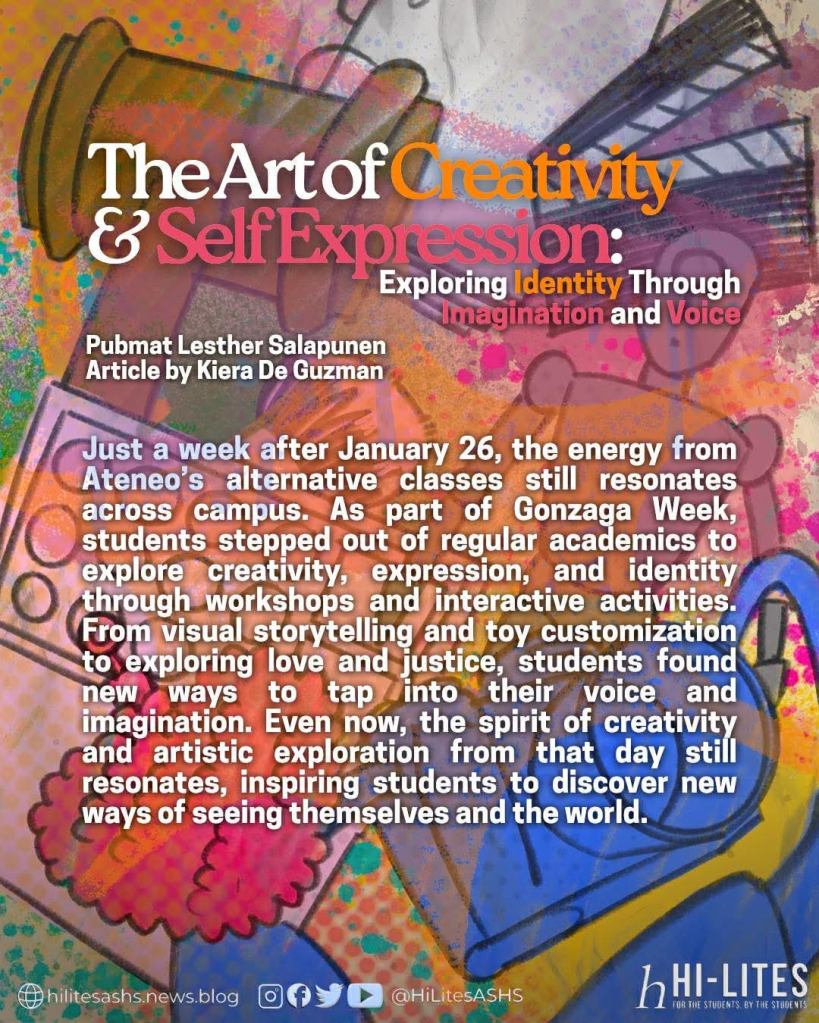
Beneath the echo of footsteps and the hum of student chatter, the Ateneo Senior High campus pulses with color and sound as students’ faces light up with glee following the launch of St. Aloysius Gonzaga Week last Monday, January 26.
More than just a break from textbooks and traditional classrooms, the event opens doors for learners to explore creativity and artistic expression through meaningful, hands-on experiences that nurture their imaginative talents and individuality.
Create. Capture. Communicate.
This Alternative Class was dedicated to visual storytelling: teaching the principles behind photography and videography, including how to adjust camera settings and use various techniques to create expressive and meaningful visual work.
Sofie Santiago from 12-Geronimo described this class as incredibly insightful and fascinating. “I think my main takeaway is that art isn’t just creative, it’s also technical. Especially photography and videography. Communicating your message to an audience through the camera requires a lot of technical considerations and manipulations,” she reflected. Through this experience, she emphasizes how important it is to balance artistic intuition with technical skill, showing that understanding both aspects deepens one’s ability to express ideas clearly and purposefully.
Having always loved film and photography but struggled to imitate the level of cinematography she admired, Sofie found the Alternative Class transformative. Instead of just playing with cameras, she learned the many elements that go into picture‑taking and filmmaking: from framing and angles to grids and color grading.
The experience helped her see that expressing emotion and ideas visually isn’t random or instinctive alone, but requires thoughtful technical choices to bring a creative vision to life.
Hooked on a Feeling (Amigurumi)
The Alternative Class, Hooked On A Feeling: Amigurumi, is a Japanese art of crocheting small yarn figures and patterns. An art of love that is manifested through bringing your own creativity to life.
“Although the process was challenging, the overall experience became more meaningful as I found beauty in every mistake that motivated me to improve my crocheting skills,” Aeron Motallana from 12-Geronimo had said, but even with the difficulties he had mentioned, the facilitators made sure no student was left behind, guiding them with a calm and optimistic disposition that deeply uplifted their spirits along the way.
“As I reflect on it, I also realize that no form of art can be created without patience and commitment. Even for a single crochet, each step is important in achieving the desired outcome that reflects our efforts and self-expression,” he expounded, highlighting that creativity isn’t just spontaneous but requires thoughtful practice and dedication to reach your desired result. He also realized that art can be a genuine expression of love — especially as he now plans to use his newfound skills to craft meaningful gifts and materials for his loved ones.
Toy Customization
Toy Customization is an Alternative Class where students bring in their own toys and transform them according to their personal vision. Using a variety of materials like paint, sculpting putty, drills, sandpaper, and more, participants learn to reimagine and rework their figures to give them a fresh personality and style.
For Rafa Balagtas of 11‑Goupil, this class was more than just transforming the old into something new — it was a once‑in‑a‑lifetime opportunity to revisit the joy of childhood, when he would play freely and imaginatively with his toys.
“I chose this class because I already had a strong interest in hobbies like customization and building toys like Legos,” he shared, emphasizing how the class gave him a space to explore his passion in a hands-on way that allowed creativity to lead the process.
He recalled his experience by saying that “customization truly had no limits.” Not only did it reignite his childlike sense of wonder and creativity, but it also revealed how creative instincts begin in childhood. The chance to personalize his own toy reminded him that his imagination can expand freely without boundaries.
The Ultimate Glow Up (Workshop on Make-up)
This Alternative Class was a makeup workshop that gave students the chance not only to learn about the history and evolution of makeup, but also to build their skills and confidence in application. More than just techniques, the class highlighted makeup as an art form — one that can boost self‑assurance and serve as a creative outlet and form of personal expression.
“This helped shape my creativity and expression because it sort of reaffirmed my belief that makeup is different for each person,” Aryana Maclang from 12-Grodecky reflected on her experience, emphasizing that makeup isn’t just about following trends, but about showing personality and individuality through color and technique.
“One of the first things we learned in the alternative class is that makeup can reflect who you are, how you feel, and what you want to communicate to someone or to the world,” she highlighted the importance of understanding that makeup isn’t just about looking a certain way, but can also be a reflection of your inner self. “The colors you pick, how bold or soft you go, whether you prefer something more natural or dramatic, it can represent your personality.”
This class was an amazing opportunity not only to improve your makeup skills and boost your confidence, but also to learn how to express yourself through art. By showing that makeup can be a personal and unique form of expression that varies from person to person, it highlighted how creativity and individuality go hand in hand.
Introduction to Events Management (Field Production)
Introduction to Events Management (Field Production) gives students a firsthand look at what happens “behind the scenes” of an event. From planning logistics and organizing entertainment to developing interesting gimmicks and coordinating the event flow, this class teaches how to manage every stage — from the initial planning process all the way through to the event day itself.
“It was quite fun! I actually expected this class to be more on the onsite film production and working with cameras, as that was what I initially thought it would be as I signed up for it,” Andie Becina of 11-Grande had said. “Nevertheless, I can say that I was pleasantly surprised that I ended up being interested in the topics that were discussed.”
She explained that one of the highlights for her was the collaborative event plan pitching activity, where she got to work with different students. “During this, I was able to brainstorm with different minds, who had several creative ideas to share, and work together to create a plan that was uniquely ours!”
Being surrounded by others who were just as eager to interact and share ideas made her more comfortable expressing her own thoughts. The experience didn’t just teach her about event planning; it also strengthened her confidence in working with others and sparked new creative energy she hadn’t expected.
Playwriting
This Alternative Class introduces students to writing scenes for the stage, allowing them to dive into their creativity while learning about story structures and key elements that guide inspiring writers. It emphasizes the importance of uniqueness and individuality in storytelling and shows that writing plays aren’t limited by rules; instead, it encourages students to imagine freely and realize that the “sky is the limit.”
“Playwriting helped me give voice to ideas, emotions, and stories that might have been difficult to express otherwise,” Ariane Tatunay from 11-Grande had expounded, noting how the class encouraged her to think more deeply about her experiences and translate feelings into words and characters. “From imagining vivid imagery and unique character traits, I was able to explore real‑life nuances, personal feelings, and social issues in a meaningful way that I hope will one day connect with others.”
In reflecting on her experience, she explained that writing for the stage gave her a place to turn thoughts and feelings into something real on the page. Playwriting isn’t just about entertainment — it lets writers explore complex ideas and emotions, use their imagination to shape characters and stories, and communicate experiences in a way others can understand.
By working on pieces that touch on personal and social themes, students build confidence in their voice and empathy for others, showing how creative writing can deepen understanding and connection with audiences.
Love Stories as Justice
This Alternative Class explored what justice was based on an approach more deeply rooted in the social sciences, and then applied it to love stories, seeing that these theories can relate to creative stories too.
Patrice Jampil from 11-Grande said that her experience attending this class was very insightful and enlightening.
“You get to see that justice isn’t always just for our HUMSS-centered classes, but can be found in everyday life and the stories that we explore and write ourselves. You get to see how such theories can enrich a story, how they let a narrative grow and allow us to better understand not just the characters but ourselves as well and the way we interpret stories,” she had reflected, pointing out that connecting themes like justice to everyday experiences and narratives helps students see how literature mirrors real life.
“Justice, as Sir Danielle taught us, is about being treated the way you deserve, and I believe that we all deserve to be loved to the fullest of one’s capacity,” she added, noting that themes like love and justice aren’t just abstract concepts studied in class but powerful lenses through which we can explore our own experiences and values. Love and justice become rich material for creative work because they tap into emotions and human relationships that writers and artists often reveal through their craft, helping them express what it means to belong, to care, and to be seen.
In the art of creativity and individuality, we discover not just new skills, but a way to express our deepest selves — turning personal experiences, emotions, and perspectives into something uniquely our own.
 HiLites ASHS