
By Gianna Ramos
By Ianella Gamallo
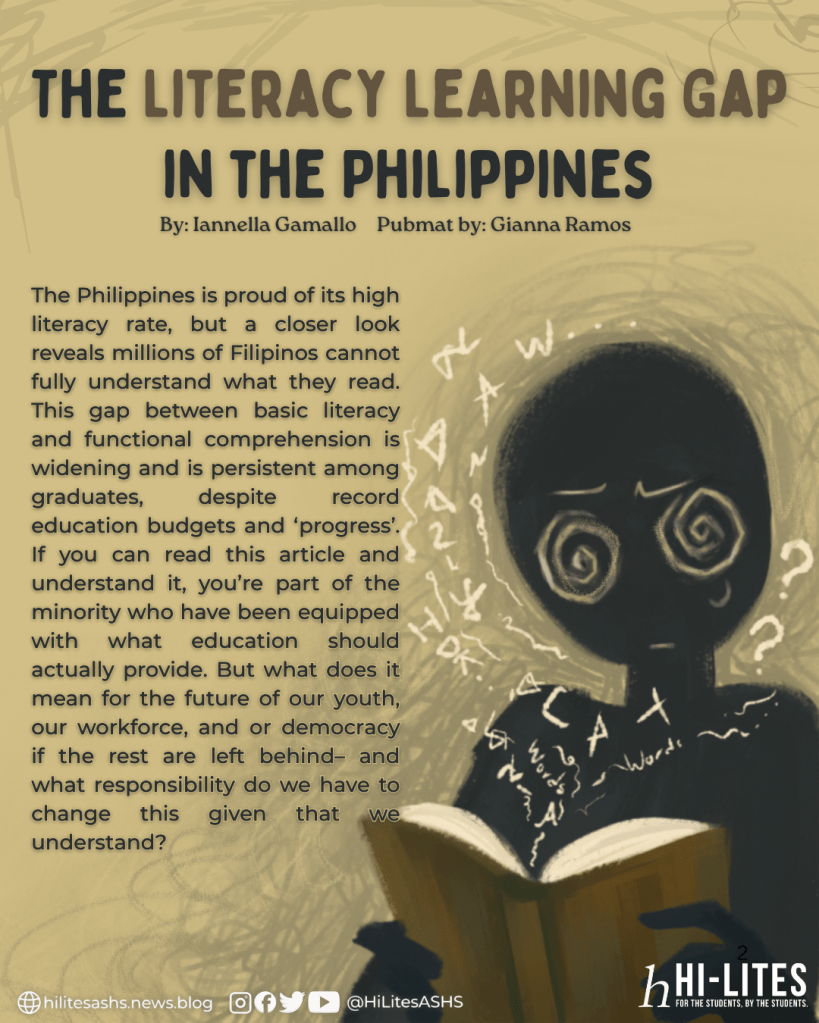
The Philippines has long celebrated its high literacy rate. Official data from the 2024 Functional Literacy, Education and Mass Media Survey (FLEMMS) shows that 93.1% of Filipinos aged 10 to 64 can read, write, and compute, a figure often used to signal the success of the country’s basic education system. But beneath this impressive headline lies a far more troubling reality. While most Filipinos can decode words on a page, many struggle to understand and apply what they read, a skill essential for life beyond the classroom.
FLEMMS reveals that only 70.8% of Filipinos are functionally literate, meaning they can read, comprehend, and use information in daily life. That is a gap of more than 22 percentage points, tens of millions of people who can read words but cannot meaningfully understand them. This is not a technical distinction. It is a learning crisis.
Graduation Does not Guarantee Literacy
What makes this gap especially alarming is that it includes those who have already passed through the education system. Analysis of the 2024 FLEMMS shows that millions of high school and junior high school graduates are still considered functionally illiterate, despite completing the basic education cycle.
This exposes a critical failure in the system. Schools are producing graduates who hold diplomas but lack the skills those diplomas are supposed to represent. The issue can no longer be explained by access alone. Education is meant to prepare students for life after school, not merely to help them pass exams or move up a grade level.
Schools themselves often lack sufficient learning materials and updated textbooks, and teachers frequently enter classrooms without the tools needed to teach real comprehension rather than rote memorization. Although public education in the Philippines is officially “free,” the quality and consistency of what students receive vary sharply across schools and regions.
No Lack of Funding, only of Results
This gap becomes even more striking when placed against government spending. In the 2026 national budget, the Department of Education was granted a historic ₱1.015 trillion allocation, the largest in its history and the first to meet UNESCO’s recommended minimum of 4% of GDP for education. On paper, the numbers suggest commitment.
In practice, however, the scale of funding does not automatically translate into better literacy outcomes. A substantial portion of the budget is absorbed by salaries and infrastructure, while literacy-specific interventions receive only a fraction of total funding. For instance, the Early Language, Literacy, and Numeracy (ELLN) program, a flagship initiative meant to strengthen foundational skills, was allocated only around ₱106 million in 2025, an amount that is negligible relative to DepEd’s overall budget.
This imbalance reflects a deeper problem in priorities. In an age where education increasingly depends on technology, updated content, and teacher training in comprehension-based instruction, many public school teachers remain under-equipped. Learning materials arrive late or incomplete, digital tools are unevenly distributed, and professional development often focuses on compliance rather than instructional depth. The result is a system that claims to offer free education, yet struggles to guarantee meaningful learning.
Why This Gap Hits the Youth the Hardest
Nearly three in ten Filipinos can read but cannot fully understand what they are reading, you are one of the fortunate seven who are capable of both.
That is not a metaphor. According to FLEMMS, 29.2% of Filipinos lack functional literacy, and a significant portion of them are young people who have already spent years inside classrooms. This means that as a student or recent graduate, you may have passed subjects, earned certificates, and moved on yet still struggle to comprehend written instructions, analyze information, or apply what you read in real-life situations.
This disadvantage follows young Filipinos directly into the workforce. Employers today demand skills rooted in comprehension: the ability to follow written instructions, understand policies, communicate clearly, and solve problems. When these skills are weak, young workers are pushed into low-paying, unstable jobs or shut out of opportunities altogether. Education, which is supposed to act as the primary bridge out of poverty, fails to guarantee employability or self-sustenance.
The consequences ripple outward. A workforce with weak comprehension is less productive and less competitive. An economy built on such a workforce struggles to grow sustainably. For young people in already disadvantaged communities where schools lack resources, teachers are stretched thin, and access to technology is limited, the literacy gap reinforces existing systems of poverty, passing inequality from one generation to the next.
Beyond economics, the cost is civic. Young citizens who cannot critically understand what they read are more vulnerable to misinformation, propaganda, and manipulation, especially in an era dominated by social media and rapid information exchange. This weakens democratic participation and undermines informed decision-making at both personal and national levels.
A National Responsibility
The literacy learning gap in the Philippines is not simply an educational concern; it is a national development crisis. Addressing it requires more than teaching students how to read words. It demands an education system that ensures learners genuinely understand and can apply what they learn.
Strengthening foundational literacy in the early years, prioritizing teacher training focused on comprehension, and redirecting resources toward learning materials that meet modern demands are not optional reforms — they are urgent necessities. Education leaders, including Education Secretary Sonny Angara, have acknowledged the severity of the challenge and pledged intensified literacy reforms through curriculum improvements and targeted interventions. Recognition, however, must translate into sustained action.
Until the gap between schooling and understanding is closed, economic growth will remain uneven, democratic participation fragile, and millions of Filipino youth will continue to graduate unprepared for the realities of adult life. Ensuring that every learner not only reads but truly comprehends is no longer just an educational goal, but a moral obligation.
 HiLites ASHS