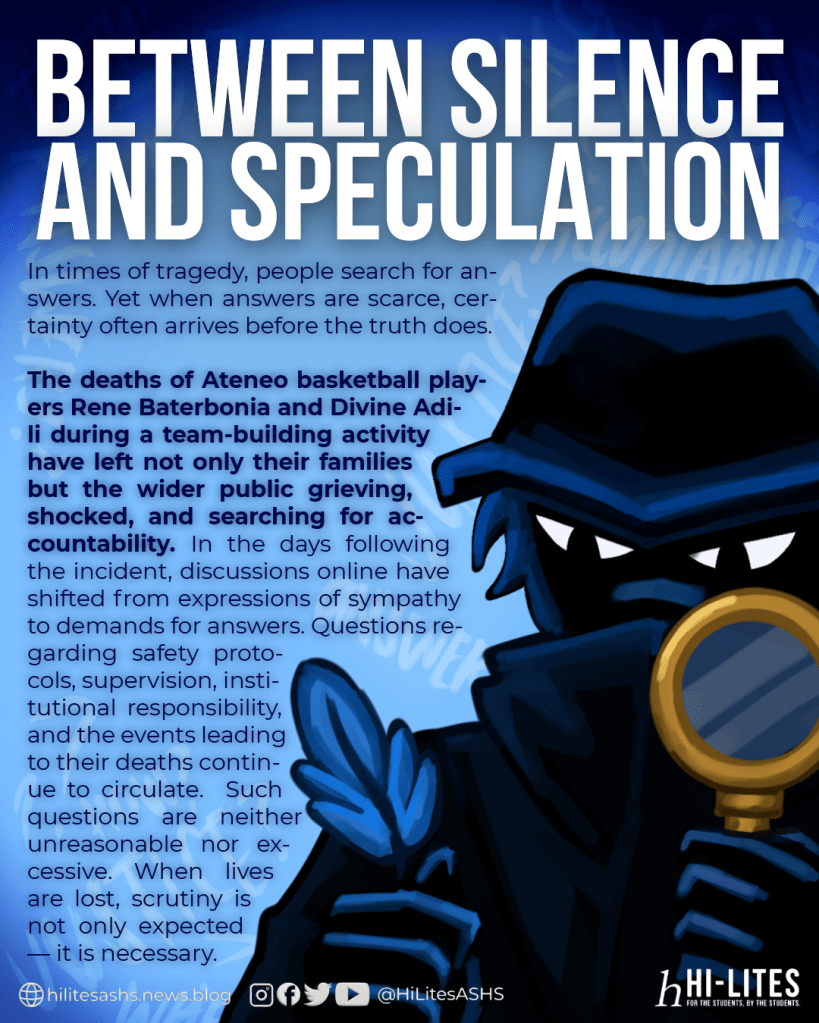
In times of tragedy, people search for answers. Yet when answers are scarce, certainty often arrives before the truth does.
The deaths of Ateneo basketball players Rene Baterbonia and Divine Adili during a team-building activity have left not only their families but the wider public grieving, shocked, and searching for accountability. In the days following the incident, discussions online have shifted from expressions of sympathy to demands for answers. Questions regarding safety protocols, supervision, institutional responsibility, and the events leading to their deaths continue to circulate. Such questions are neither unreasonable nor excessive. When lives are lost, scrutiny is not only expected — it is necessary.
This sentiment is perhaps best reflected in the public statements of Rene’s mother, who herself has raised questions regarding the circumstances surrounding her son’s death. Her grief mirrors that of a community struggling to understand how such a tragedy could have occurred.
For many students, the incident has also become a source of unease. We are often taught to view schools, athletic programs, and organized activities as spaces designed for growth, development, and safety. Yet tragedies such as this inevitably raise difficult questions. If something like this could happen during an organized activity, what does that mean for the trust students place in the institutions responsible for their welfare?
Institutions entrusted with the welfare of students and athletes have a duty of care, and existing policies governing sports activities and coaching responsibilities exist precisely because athlete safety should never be left to chance. In this context, the tragedy feels especially personal to students as it occurred in spaces they, too, are taught to trust.
When Questions Become Conclusions
Yet while scrutiny is necessary, it must not be confused with assumption.
In the aftermath of the incident, numerous allegations and theories have circulated online. Claims regarding weights allegedly tied to bodies, assertions that the activity constituted hazing, and accounts assigning blame to specific individuals spread rapidly across social media platforms. Some versions of these claims contradicted one another, while others evolved with each retelling. Nevertheless, many were accepted as fact long before investigations had concluded.
This illustrates a dangerous shift from questioning to concluding. Scrutiny seeks answers; assumption claims to already possess them.
Perhaps most concerning is how quickly unverified claims can shape public perception. Reports indicate that even grieving family members encountered information circulating online that had yet to be substantiated through official investigations. In moments of uncertainty, rumors often appear convincing not because they are proven, but because they provide immediate explanations for painful questions.
The Cost of Certainty
As investigations progressed, authorities released findings and addressed several circulating allegations. Official reports and autopsy findings were made public, while authorities and various parties sought to clarify misinformation that had spread online. The University itself later released public fact-checks addressing some of the most widely circulated claims. Yet despite these efforts, many members of the public remained unconvinced, dismissing official findings outright and continuing to embrace narratives that aligned with their existing suspicions.
This raises an uncomfortable question: If evidence is rejected before it is examined, what becomes of accountability?
Accountability depends on evidence. It requires facts that can be verified, testimonies that can be scrutinized, and findings that can withstand examination. When conclusions are formed first and evidence is evaluated only according to whether it supports those conclusions, the search for truth risks becoming secondary to the desire for validation.
The Vacuum Between Silence and Speculation
However, public distrust did not emerge in a vacuum.
The spread of speculation was facilitated by gaps in communication that many perceived as insufficient. The University’s initial statements focused primarily on confirming the deaths and expressing condolences. Subsequent communications outlined actions taken in response to the tragedy, but for many observers, these statements left critical questions unanswered regarding the events themselves. At the same time, statements from authorities and sports officials, including observations that aspects of the activity may not have met expected standards, generated further concern while providing limited clarity regarding the precise circumstances involved.
In the absence of detailed explanations, people sought answers elsewhere.
Among students and young athletes, the lack of clarity has produced more than curiosity — it has produced uncertainty. Trust is built not only on an institution’s reputation but also on its willingness to communicate during moments of crisis. When information remains limited, questions naturally emerge about athlete safety, accountability, and whether existing safeguards are sufficient. The issue extends beyond one incident; it influences how students perceive the institutions entrusted with their care.
This does not justify the spread of misinformation, but it helps explain why it flourished. When institutions communicate too little, speculation rushes in to fill the void. When speculation dominates public discourse, verified information struggles to regain ground. One creates the conditions for confusion; the other deepens it.
The result is a cycle in which institutional silence fuels public conjecture, while public conjecture further erodes trust in institutions.
Accountability Requires Evidence
Lost in this cycle are the very people at the center of the tragedy.
Rene and Divine deserve more than competing narratives. Their families deserve more than rumors and assumptions. The community deserves more than fragmented accounts and unanswered questions. What they deserve is the truth.
For students, this tragedy is not merely a controversy unfolding online. It is a reminder that the systems meant to protect us are only as strong as the accountability that sustains them. The questions raised by the deaths of Rene and Divine are not solely about what happened that day, but about the kind of environment students deserve moving forward — one where safety is prioritized, transparency is practiced, and trust is earned rather than assumed.
Yet truth cannot emerge from institutional silence, nor can it be reached through conclusions formed before investigations are complete. The pursuit of accountability requires transparency from institutions and restraint from the public. It requires difficult questions, but also a willingness to follow evidence wherever it leads.
Because accountability is not the enemy of evidence — it depends on it.

